

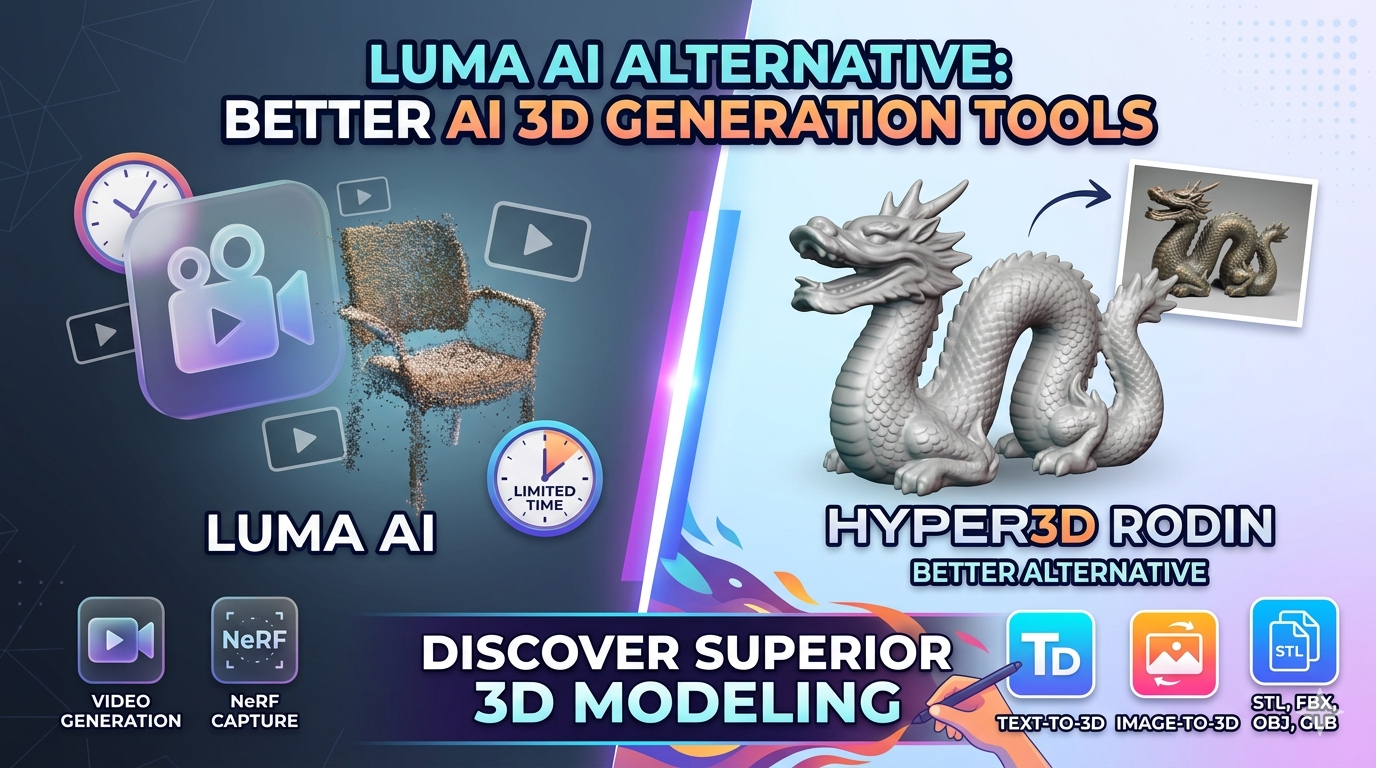
Luma AI Alternative: Better AI 3D Generation Tools
Luma AI has carved out a unique space in the AI-powered creative toolkit by offering both impressive video generation and 3D scene capture. This dual functionality makes it a go-to for many creators. However, the world of AI tools is vast and specialized, and for many, a dedicated tool might be a better fit. If you're looking for a Luma AI alternative, especially for 3D model generation, you've come to the right place. We'll explore some of the best alternatives, including our own Hyper3D Rodin, to help you find the perfect tool for your workflow.
Luma Ai Alternative: Understanding Luma AI's Strengths and Weaknesses
To find the right alternative, it's important to understand what Luma AI does well and where it has limitations.
Luma Ai Alternative: What Luma AI Does Well
Luma AI is known for its high-quality, photorealistic video output. Its integrated 3D-to-video pipeline is a significant advantage for creators who want to generate video from 3D scenes. The Dream Machine is a powerful tool for creating impressive video clips from text or images.
Where Luma AI Falls Short
Despite its strengths, Luma AI has some limitations. The free plan has restrictive caps, and even on paid plans, video clip length is limited. It also lacks native audio generation, a feature offered by some competitors. When it comes to 3D generation, while Luma's NeRF technology is powerful, it may not be the best fit for all use cases, and the output can be difficult to work with in traditional 3D software.
Top Alternatives to Luma AI for 3D Generation
For those who are primarily focused on 3D model generation, there are several excellent Luma AI alternatives to consider.
Hyper3D Rodin: A Great Alternative to Luma AI
Hyper3D Rodin is a powerful AI 3D generation tool that excels where Luma AI's 3D capabilities can be challenging. Rodin is designed to be a user-friendly and versatile tool for creating high-quality 3D models from both text and images. With our image to 3D and text to 3D model tools, you can generate stunning 3D assets in minutes. Rodin offers a range of generation modes, including Gen-2, Default, Focal, Zero, and Speedy, allowing you to choose the best option for your specific needs. The models are also easy to export in a variety of formats, including STL, FBX, OBJ, GLB, and USDZ, making them compatible with most 3D software and game engines.
Polycam: For Mobile 3D Scanning
Polycam is a popular choice for mobile 3D scanning. It's particularly effective on devices with LiDAR scanners, where it can create clean and accurate meshes. This makes it a great option for scanning real-world objects and environments. While it doesn't have the AI-powered text-to-3D generation of Luma AI or Hyper3D, it's a powerful tool for capturing existing objects in 3D.
Nerfstudio: For Researchers and Technical Users
For those with a more technical background, Nerfstudio is an open-source framework that provides a high degree of control over the NeRF reconstruction process. It's a powerful tool for research and for users who want to dive deep into the technical details of neural radiance fields. However, it requires a significant amount of technical expertise to set up and use effectively.
My First-Hand Experience with 3D Generation Tools
As someone who has spent a lot of time exploring the world of AI 3D generation, I've had the opportunity to use a variety of tools, including Luma AI and our own Hyper3D Rodin. While Luma AI is impressive, I've found that for my 3D modeling workflow, Hyper3D Rodin offers a more streamlined and user-friendly experience. The ability to generate high-quality models from a single image or a simple text prompt is a major improvement. I've been particularly impressed with the quality of the models generated using the
Gen-2 mode, which produces incredibly detailed and realistic results. The variety of export formats also makes it easy to integrate the models into my existing workflow.
Objective Comparison of 3D Generation Tools
To help you choose the right tool, here is a comparison of Luma AI and its top 3D generation alternatives:
| Feature | Luma AI | Hyper3D Rodin | Polycam | Nerfstudio |
|---|---|---|---|---|
| 3D Generation Quality | High (NeRF) | High (Mesh) | High (Mesh) | Very High (NeRF) |
| Ease of Use | Moderate | Easy | Easy | Difficult |
| Input | Video, Text | Text, Image | Photos, LiDAR | Video, Photos |
| Export Formats | GLB, USDZ | STL, FBX, OBJ, GLB, USDZ | OBJ, FBX, GLB, STL | PLY, NERF |
| Pricing | Free & Paid | Free & Paid | Free & Paid | Free (Open Source) |
| Best For | Video from 3D | Quick, high-quality 3D models | Mobile 3D scanning | Research, technical users |
As you can see, while Luma AI is a strong contender, Hyper3D Rodin offers a more accessible and versatile solution for most users who are focused on 3D model generation. Our ChatAvatar tool is another great option for creating custom avatars.
Alternatives to Luma AI for Video Generation
While our focus at Hyper3D is on 3D generation, keep in mind that there are many excellent Luma AI alternatives for video generation. Tools like Runway, Kling AI, and Sora are all powerful options for creating high-quality video from text or images. The 3D models you create with Hyper3D can be used as assets in these video generation workflows, giving you even more creative possibilities.
FAQ about Luma AI and its Alternatives
What is the best free alternative to Luma AI?
For 3D generation, Hyper3D offers a generous free tier that allows you to create and export high-quality 3D models. For video generation, Pika has a free tier that is great for social media content.
Can I use an alternative to Luma AI for commercial projects?
Most Luma AI alternatives, including Hyper3D, offer commercial licenses that allow you to use the assets you create in your commercial projects. Be sure to check the licensing terms of the specific tool you are using.
What is the difference between NeRF and photogrammetry?
NeRF (Neural Radiance Fields) is a newer technology that uses AI to create a 3D representation of a scene from a series of images. Photogrammetry is a more traditional technique that uses software to stitch together a 3D model from a set of photos. Both can produce high-quality results, but NeRF is often better at capturing complex lighting and reflections.
How do I choose the right alternative to Luma AI for my needs?
The best Luma AI alternative for you will depend on your specific needs. If you are a researcher or have a strong technical background, Nerfstudio might be a good choice. If you need to do a lot of mobile 3D scanning, Polycam is a great option. For most users who want to create high-quality 3D models quickly and easily, Hyper3D is the best all-around alternative.
Is Hyper3D a good alternative to Luma AI?
Yes, Hyper3D is an excellent Luma AI alternative, especially for users who are focused on 3D model generation. It offers a more user-friendly experience, a wider range of export formats, and comparable or better quality for 3D models.
Conclusion
While Luma AI is a powerful and popular tool, it's not the only option for AI-powered 3D generation. For many users, a specialized tool like Hyper3D Rodin will be a better fit. With its ease of use, high-quality output, and versatile export options, Hyper3D is the ideal alternative to Luma AI for anyone who wants to create stunning 3D models without the steep learning curve. We encourage you to give it a try and see for yourself!