

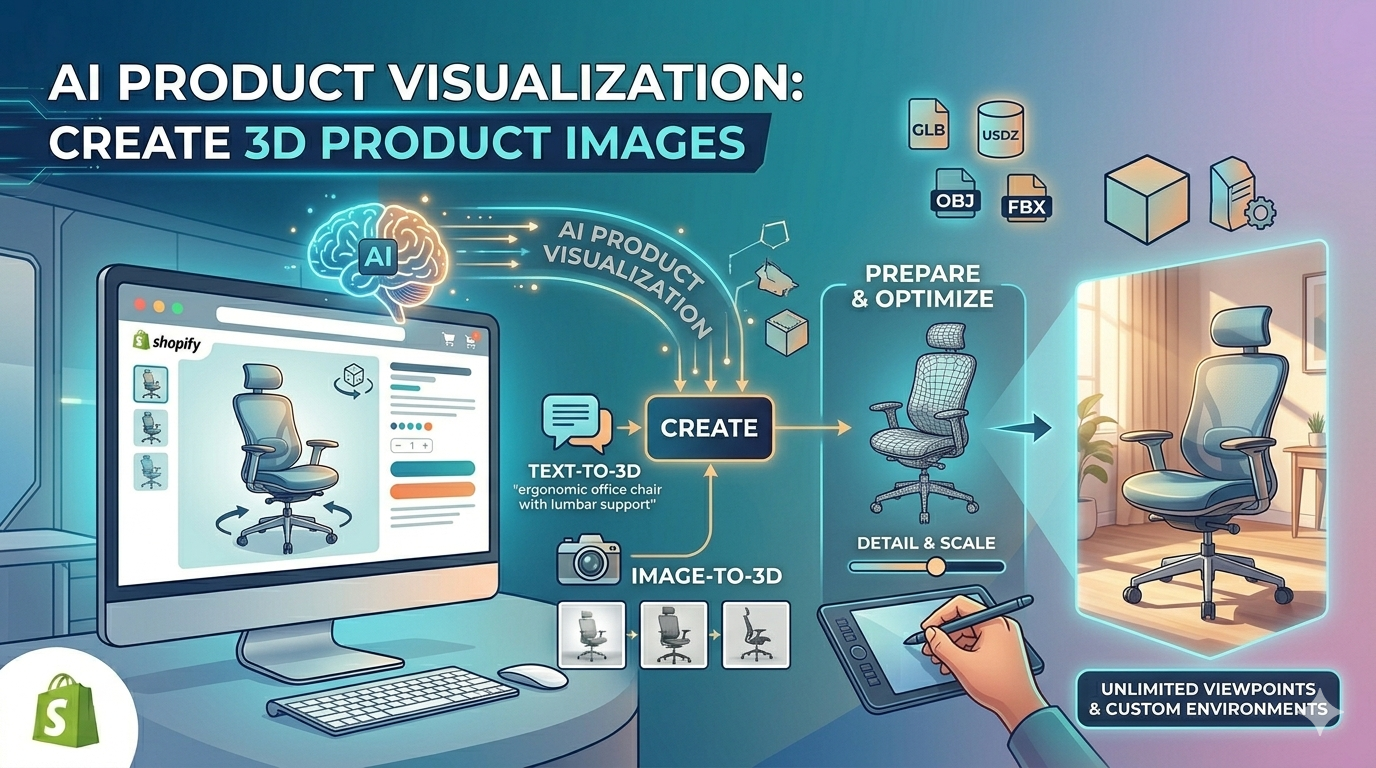
AI Product Visualization: Create 3D Product Images
In the world of e-commerce, captivating product visuals are not just a nice-to-have; they are essential. Customers want to inspect products from every angle before making a purchase. While traditional product photography has been the go-to method, it often comes with high costs, long turnaround times, and a lack of flexibility. This is where AI product visualization is making a significant impact, offering a more efficient and dynamic way to create stunning 3D product images. Platforms like Hyper3D, Sloyd.ai, and Vizcom are leading of this transformation, providing powerful tools for businesses of all sizes.
What is AI Product Visualization?
Beyond Traditional Product Photography
Traditional photoshoots, while capable of producing beautiful images, are often a logistical nightmare. They require booking photographers, renting studios, and coordinating product shipments. The entire process can be expensive and time-consuming. Also, if you want to showcase your product in different colors or settings, you often need to start from scratch. This is where the limitations of traditional methods become apparent.
AI product visualization, on the other hand, offers a more agile and cost-effective solution. By creating a 3D model of your product, you can generate an endless variety of images with different backgrounds, lighting, and angles. This not only saves time and money but also provides a level of creative freedom that is simply not possible with traditional photography.
How AI is Transforming Product Imagery
The core of AI product visualization lies in its ability to generate 3D models from simple inputs like text or images. This is made possible by advanced machine learning algorithms that can understand and interpret these inputs to create detailed and realistic 3D assets. The two primary methods for this are text-to-3D and image-to-3D generation.
With these technologies, businesses can quickly create a digital inventory of their products, which can then be used to generate a wide range of marketing materials. From interactive 3D viewers on your website to stunning visuals for your social media campaigns, AI-powered product visualization is changing the way we think about product imagery.
How to Create 3D Product Images with AI
From Text to 3D Model
One of the most exciting developments in AI is the ability to create 3D models from a simple text description. With a text-to-3D generator, you can describe the product you want to create, and the AI will generate a 3D model based on your prompt. For example, you could write, ?? vintage leather armchair with wooden legs,??and the AI would create a 3D model that matches that description.
To get the best results, it?? important to be as descriptive as possible. The more detail you provide, the more accurate the final model will be. You can specify everything from the material and color to the style and shape of the product. This technology is perfect for quickly prototyping new product ideas or creating unique assets for your marketing campaigns.
From Image to 3D Model
If you already have images of your product, you can use an image to 3D converter to create a 3D model. This process is incredibly simple: you upload a product photo, and the AI analyzes the image to construct a 3D model. For the best results, it?? recommended to use a clear, high-quality image with a simple background.
This method is ideal for businesses that already have a catalog of product photos and want to transition to 3D visualization. It?? a fast and efficient way to create a digital twin of your physical products, which can then be used in a variety of applications, from e-commerce to augmented reality.
My First-Hand Experience with AI Product Visualization Tools
Testing Hyper3D's Rodin Generator
As someone who is always on the lookout for new and innovative technologies, I was eager to try out Hyper3D?? AI 3D model generator. I decided to test the Rodin generator, which is designed for creating high-quality 3D models from text prompts. I was immediately impressed by the user-friendly interface, which made it easy to get started.
I experimented with a few different prompts and was impressed by the speed and quality of the generated models. I also explored the different generation modes, such as Gen-2, Focal, and Speedy. Each mode offers a different balance of speed and detail, allowing you to choose the best option for your specific needs. The ability to export the models in various formats, including GLB, OBJ, and USDZ, using the 3D format converter is also a huge plus.
Exploring Other AI Visualization Platforms
In addition to Hyper3D, I also spent some time exploring other AI visualization platforms like Sloyd.ai and Meshy.ai. Sloyd.ai offers a similar text-to-3D and image-to-3D workflow, with a focus on creating clean, game-ready assets. Meshy.ai, on the other hand, is geared more towards artists and designers, with a powerful set of tools for refining and customizing 3D models.
While each platform has its own strengths and weaknesses, I found that Hyper3D?? AI product 3D generator offered the best combination of ease of use, quality, and affordability. The platform is clearly designed with e-commerce businesses in mind, with a focus on creating high-quality product visuals with minimal effort.
Objective Comparison of AI Product Visualization Tools
To give you a better idea of how Hyper3D stacks up against the competition, I??e created a table comparing it with two other popular AI visualization tools: Sloyd.ai and Meshy.ai.
| Feature | Hyper3D | Sloyd.ai | Meshy.ai |
|---|---|---|---|
| Ease of Use | Excellent | Very Good | Good |
| Text-to-3D | Yes | Yes | Yes |
| Image-to-3D | Yes | Yes | Yes |
| Output Quality | High | High | Very High |
| Pricing | Freemium | Freemium | Freemium |
| Target Audience | E-commerce | Game Devs | 3D Artists |
As you can see, all three platforms offer a similar set of features. However, there are some key differences to consider. Hyper3D is the most user-friendly of the three, making it a great choice for beginners. Sloyd.ai is a good option for game developers, with a focus on creating optimized assets. Meshy.ai is the most powerful of the three, but it also has the steepest learning curve.
Key Features to Look for in AI Product Visualization Software
AI-Powered Backgrounds and Environments
One of the most powerful features of AI product visualization software is the ability to generate custom backgrounds and environments. This allows you to showcase your product in a variety of settings, from a clean studio background to a realistic lifestyle scene. This is a great way to create engaging and eye-catching product visuals that will capture the attention of your customers.
Material and Texture Customization
Another important feature to look for is the ability to customize the materials and textures of your 3D models. This allows you to showcase your product in different colors and finishes, without the need to create multiple 3D models. This is a huge time-saver and allows you to create a more personalized shopping experience for your customers.
Lighting and Rendering Options
Finally, it?? important to choose a platform that offers a variety of lighting and rendering options. This will allow you to create a wide range of different looks, from photorealistic to stylized. The ability to control the lighting and rendering is essential for creating high-quality product visuals that accurately represent your brand.
The Future of Product Visualization
The world of AI product visualization is constantly evolving, with new and exciting developments on the horizon. We are already seeing the emergence of AI-generated videos, which will allow businesses to create dynamic and engaging product videos with minimal effort. We are also seeing the integration of AI with augmented reality, which will allow customers to visualize products in their own homes before making a purchase.
As these technologies continue to mature, we can expect to see even more innovative applications of AI in the world of e-commerce. The future of product visualization is bright, and I for one am excited to see what?? next.
FAQ
What is the best AI for product visualization?
There is no one-size-fits-all answer to this question, as the best AI for product visualization will depend on your specific needs and budget. However, platforms like Hyper3D, Sloyd.ai, and Meshy.ai are all excellent options to consider. For e-commerce businesses, an e-commerce 3D model generator like the one from Hyper3D is a great choice.
How much does AI product visualization cost?
The cost of AI product visualization can vary widely depending on the platform and the features you need. Many platforms offer a freemium model, which allows you to get started for free and then upgrade to a paid plan as your needs grow. Paid plans typically range from $10 to $100 per month.
Can I use AI to create 3D models for my Shopify store?
Yes, you can absolutely use AI to create 3D models for your Shopify store. Many AI visualization platforms offer direct integration with Shopify, making it easy to add 3D models to your product pages. This is a great way to enhance the shopping experience and boost your sales.
What file formats do AI 3D model generators support?
Most AI 3D model generators support a variety of standard file formats, including GLB, OBJ, FBX, and STL. This makes it easy to import your models into other 3D software for further editing or rendering. Some platforms, like Hyper3D, also offer a built-in 3D format converter.
How realistic are AI-generated product images?
The realism of AI-generated product images can vary depending on the platform and the quality of the input. However, with the right tools and techniques, it is possible to create incredibly realistic product images that are virtually indistinguishable from traditional photographs. As the technology continues to improve, we can expect to see even more realistic results in the future.