

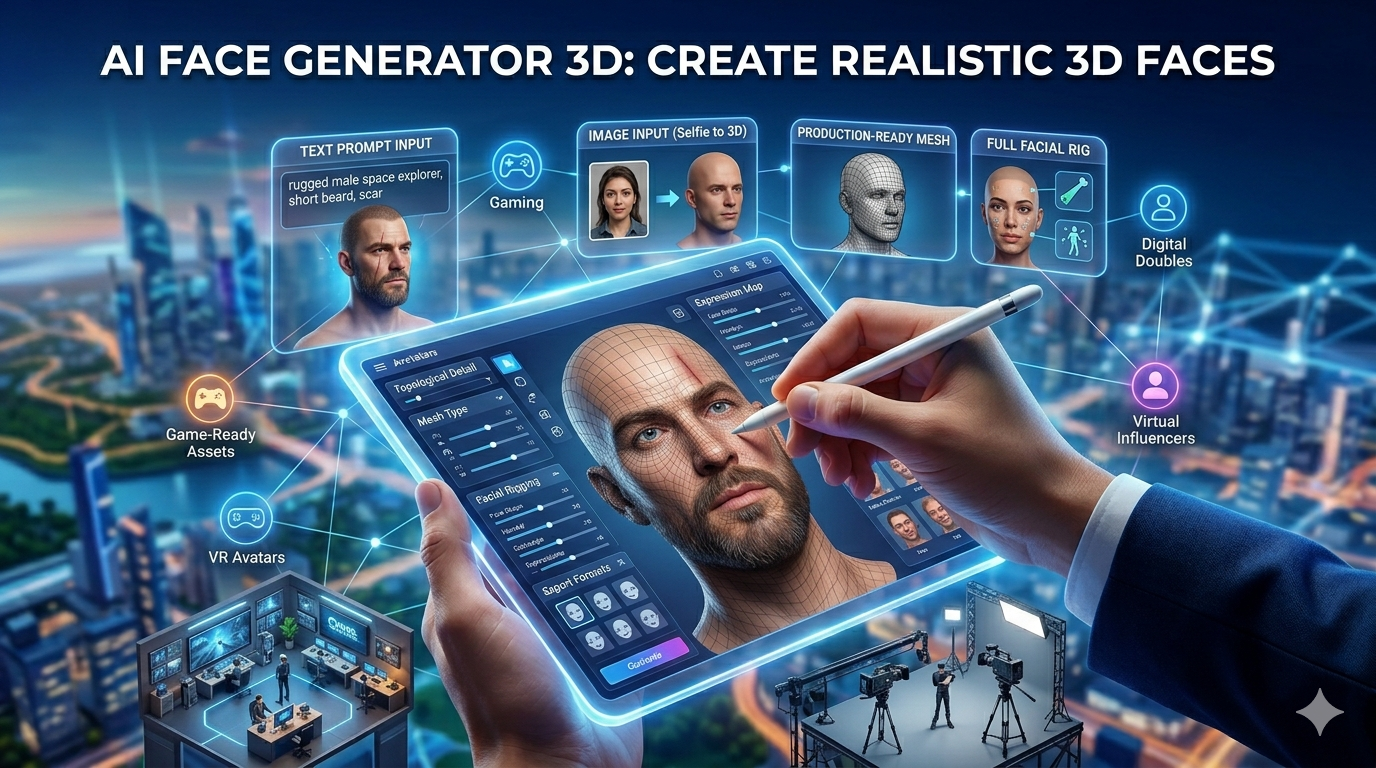
AI Face Generator 3D: Create Realistic 3D Faces
The demand for realistic digital humans is growing across industries, from game development and filmmaking to virtual reality and marketing. Creating these digital faces manually is a time-consuming and highly skilled process. This is where AI-powered face generation tools come in, offering a powerful solution to create stunningly realistic human faces from simple text prompts or images. Tools like Midjourney, Stable Diffusion, and specialized platforms such as Hyper3D's ChatAvatar are making this technology more accessible than ever. Whether you need a 2D portrait or a fully rigged 3D face model, these tools can produce high-quality results in a fraction of the time.
What is an AI Face Generator?
An AI tool for generating faces uses artificial intelligence, specifically generative adversarial networks (GANs) or diffusion models, to create new, synthetic human faces. These faces can be photorealistic or stylized, and the technology can generate them from various inputs like text descriptions, uploaded photos, or even by combining existing faces. Some advanced generators can even produce 3D models of faces, complete with textures and rigging for animation. This technology has applications in creating avatars, non-player characters (NPCs) for games, virtual influencers, and even for generating data to train other AI models.
How Do AI Face Generators Work?
Most of these tools are trained on massive datasets of real human faces. The AI learns the patterns, features, and variations that make up a human face. When a user provides a prompt, the AI uses this learned knowledge to generate a new face that matches the description. For 3D face generation, the process is more complex, often involving creating a 3D mesh and then applying textures and materials to create a realistic appearance. Some tools, like Hyper3D's ChatAvatar AI avatar generator, are specifically designed to streamline the creation of 3D faces and avatars.
Top AI Face Generator Tools for 2D and 3D
The market is filled with various tools for generating faces, each with its strengths. Some excel at creating photorealistic 2D portraits, while others focus on generating game-ready 3D models.
For 2D Photorealistic Faces
- Midjourney: Known for its artistic and high-quality image generation, Midjourney can create incredibly realistic faces with detailed prompts. It's great for concept art and high-fidelity portraits.
- Stable Diffusion: An open-source model that offers a high degree of customization. With the right models and settings, it can produce stunningly realistic faces. It requires more technical know-how but provides greater control.
- Adobe Firefly: Integrated into Adobe's ecosystem, Firefly's AI face generator is trained on licensed content, making it a safe choice for commercial projects. It's user-friendly and produces high-quality, commercially viable images.
For 3D Face and Character Creation
- Hyper3D (ChatAvatar): As a specialized 3D face generation tool, Hyper3D's ChatAvatar excels at creating detailed 3D faces and avatars from text prompts or images. It's part of a larger suite of tools, including an AI 3D model generator and a powerful vector to 3D converter, making it a comprehensive solution for 3D asset creation.
- Luma AI: Luma AI offers a text-to-3D feature that can generate 3D models of faces and characters. It's known for its fast generation times and high-quality results, making it a popular choice for artists and developers.
- Masterpiece X: This platform provides a complete suite of tools for creating and editing 3D models, including a text-to-3D generator. It's designed for professional use and offers features like auto-rigging and animation.
My First-Hand Experience with an AI Face Generator
As a 3D artist, I'm always looking for tools that can speed up my workflow without sacrificing quality. I decided to try Hyper3D's ChatAvatar, to create a character for a personal project. I started with a simple text prompt: "a rugged male space explorer with a short beard and a scar over his left eye." Within a minute, ChatAvatar generated a 3D model of a face that closely matched my description.
The level of detail was impressive. The skin had a subtle texture, the beard looked natural, and the scar was perfectly placed. I was able to rotate the model and view it from all angles. The topology of the mesh was clean, which is crucial for animation. I then used Hyper3D's OmniCraft tool to refine the model further, adjusting the lighting and materials. The ability to export the model in various formats, including FBX and GLB, was a huge plus, as it allowed me to easily import it into my preferred 3D software. The entire process, from prompt to a game-ready asset, took less than 15 minutes. For anyone needing a quick and efficient way to create 3D characters, I highly recommend exploring a dedicated character design generator.
Objective Comparison of AI Face Generators
Choosing the right tool depends on your specific needs. Here?? a comparison of some of the top tools:
| Feature | Hyper3D (ChatAvatar) | Midjourney | Luma AI |
|---|---|---|---|
| Primary Use | 3D Face & Avatar Generation | 2D Artistic Image Generation | 3D Model Generation |
| Input | Text, Image | Text | Text |
| Output | 3D Models (FBX, GLB, etc.) | 2D Images (PNG) | 3D Models (GLB, USDZ) |
| Ease of Use | Very Easy | Moderate | Easy |
| Customization | High (within Hyper3D suite) | High (with prompts) | Moderate |
| Best For | Game Devs, 3D Artists, VR | Concept Artists, Illustrators | 3D Artists, AR/VR Devs |
Pros and Cons:
- Hyper3D (ChatAvatar):
- Pros: Specialized for 3D face generation, clean topology, multiple export formats, integrated with a full 3D tool suite including an image to 3D converter.
- Cons: Primarily focused on 3D, so not the best choice for 2D portraits.
- Midjourney:
- Pros: Produces stunning, artistic 2D images, highly creative results.
- Cons: Not a 3D generator, requires Discord to use, prompt engineering can be complex.
- Luma AI:
- Pros: Fast generation, high-quality 3D models, user-friendly interface.
- Cons: Fewer customization options compared to a full 3D suite like Hyper3D.
For those who need to convert existing images or text into 3D models, exploring a text to 3D model tool or an AI texture generator can be a great starting point. The choice of tool ultimately comes down to whether your project requires 2D images or fully functional 3D assets.
FAQ about AI Face Generators
What is the best tool for generating AI faces?
The "best" tool depends on your needs. For high-quality 2D portraits, Midjourney is a top contender. For creating game-ready 3D faces and avatars, Hyper3D's ChatAvatar is an excellent choice due to its specialization and integration with other 3D tools.
Can I use AI-generated faces for commercial projects?
This depends on the terms of service of the tool you use. Some generators, like Adobe Firefly, are trained on licensed data and are safe for commercial use. Others may have restrictions, so it's crucial to check the licensing agreement before using generated faces in commercial work.
How realistic are AI-generated faces?
The realism of AI-generated faces has improved dramatically. Many generators can now produce faces that are indistinguishable from real photographs. The level of realism can often be controlled by the user's input and the specific model being used.
Can these tools create 3D models?
Yes, some advanced tools, like Hyper3D's ChatAvatar and Luma AI, are specifically designed to create 3D models of faces. These models can often be exported in standard formats for use in games, animation, and VR. For more advanced format needs, a 3D format converter can be very helpful.
Is it difficult to use an AI face generator?
Most modern tools for this purpose are designed to be user-friendly. Many operate with simple text prompts, allowing users to describe the face they want to create. While some tools offer more advanced settings for greater control, the basic functionality is typically very accessible, even for beginners. For those looking to create animated characters, an animation 3D generator might be the next step in their creative journey.
The Future of AI Face Generation
The field of AI face generation is evolving at a breathtaking pace. We are moving beyond static images and simple 3D models towards fully interactive, emotionally expressive digital humans. The integration of advanced AI techniques, such as real-time emotion recognition and natural language processing, will enable the creation of virtual avatars that can interact with users in a truly meaningful way. Imagine a virtual customer service agent that can show empathy or a digital companion that can react to your mood. These advancements will be powered by more sophisticated generative models and larger, more diverse datasets.
Another exciting frontier is the real-time generation of faces and characters directly within applications. This would allow for dynamic and unique experiences in games, where NPCs could be generated on the fly, each with a distinct appearance and personality. In filmmaking, this technology could be used to create digital extras or even to de-age actors with unprecedented realism. The ethical implications of this technology will also continue to be a major focus, with a growing need for solid watermarking and detection techniques to prevent misuse. As the technology becomes more powerful and accessible, the creative possibilities are boundless, promising a future where digital humans are an integral part of our daily lives.