

Resin 3D Printing: FDM vs. Resin Complete Guide
Choosing the right 3D printing technology can feel like a major decision, especially with how rapidly the field is evolving. Two of the most popular methods available to consumers and professionals alike are Fused Deposition Modeling (FDM) and resin-based printing, often referred to as Stereolithography (SLA) or Digital Light Processing (DLP). Both can turn a digital design into a physical object, but they go about it in very different ways, resulting in distinct advantages and disadvantages. Whether you're a hobbyist creating intricate miniatures, an engineer prototyping a new part, or an artist exploring new forms, understanding the nuances of resin vs FDM 3D printing is key to getting the results you want.
This guide will break down the core differences between these two powerful technologies. We'll look at everything from print quality and material options to speed, cost, and the all-important post-processing workflow. We'll also touch on how modern tools like an AI 3D printing model generator can streamline your design process, regardless of the printer you ultimately choose.
What is FDM 3D Printing?
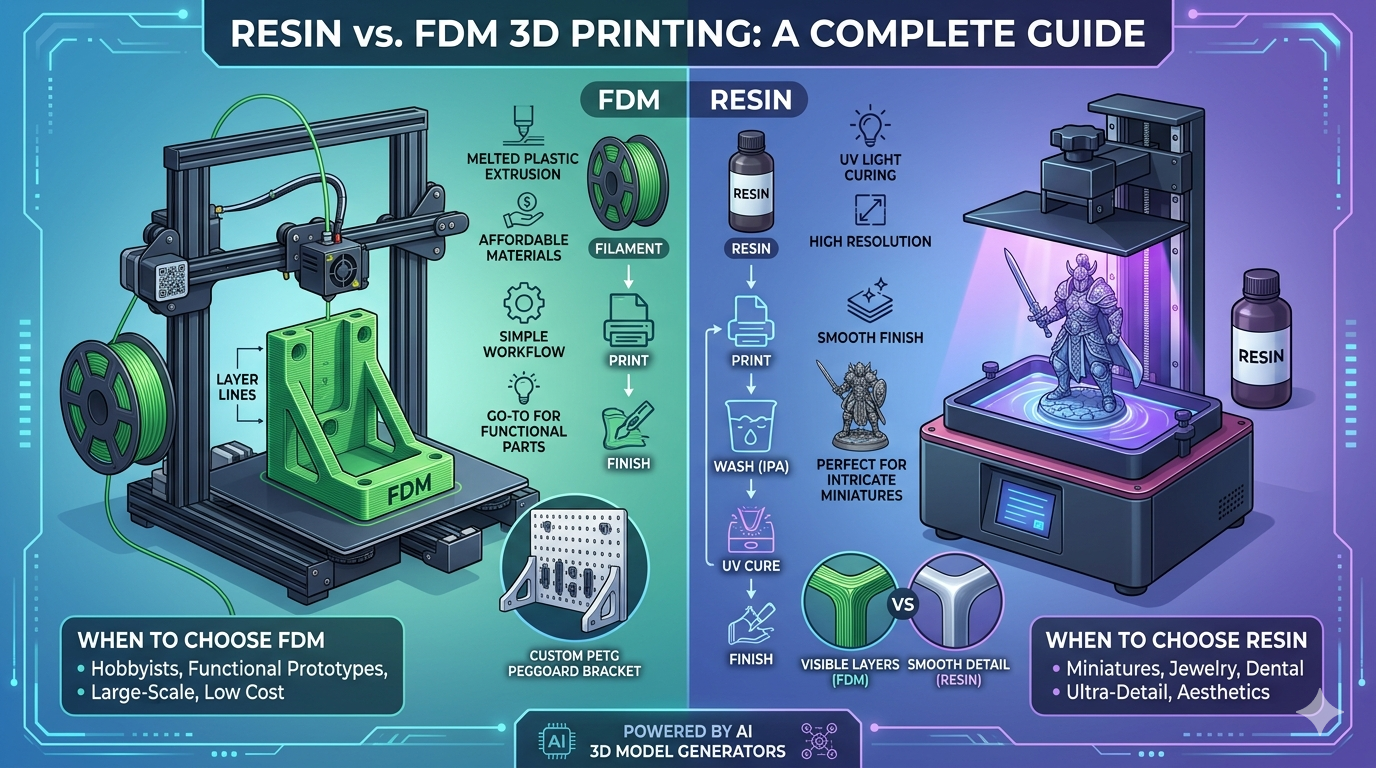
FDM, or Fused Deposition Modeling, is likely what most people picture when they think of 3D printing. It's the technology that brought 3D printing into the mainstream, thanks to its relative simplicity and affordability. It works by melting a plastic filament and extruding it layer by layer through a nozzle to build up an object. Think of it like a robotic hot glue gun meticulously drawing an object from the ground up.
How FDM Printers Work
An FDM printer feeds a spool of thermoplastic filament into a heated extruder assembly, often called the
print head." The print head moves along the X and Y axes while the build plate moves on the Z axis, allowing it to deposit the molten plastic precisely according to the 3D model file. Each layer fuses to the one below it as it cools and solidifies. This additive process is repeated, layer by layer, until the entire object is formed. The visibility of these layers is a defining characteristic of FDM prints.
Common Materials for FDM
One of the greatest strengths of FDM printing is the vast and ever-growing library of materials. These filaments are generally affordable and come in a wide variety of colors and properties:
- PLA (Polylactic Acid): This is the go-to for most beginners. It's a biodegradable thermoplastic derived from renewable resources like corn starch. It prints at low temperatures, doesn't require a heated bed, and has minimal warping, making it very forgiving.
- ABS (Acrylonitrile Butadiene Styrene): The same plastic used to make LEGO bricks, ABS is known for its strength, toughness, and heat resistance. It's a great choice for functional parts that need to withstand mechanical stress, but it can be trickier to print, requiring a heated bed and often an enclosure to prevent warping.
- PETG (Polyethylene Terephthalate Glycol): Offering the best of both PLA and ABS, PETG is a popular all-rounder. It's stronger and more durable than PLA but easier to print than ABS. It also has good chemical resistance.
- TPU (Thermoplastic Polyurethane): This is a flexible, rubber-like material perfect for creating things that need to bend and stretch, like phone cases, custom grips, or RC car tires.
What is Resin 3D Printing?
Resin 3D printing represents a different approach to additive manufacturing. Instead of melting plastic, these printers use a liquid photopolymer resin that solidifies (or cures) when exposed to a specific wavelength of UV light. This category includes technologies like SLA and DLP.
How Resin Printers Work
A resin printer has a tank, or vat, of liquid resin and a build platform that lowers into it, leaving a very thin layer of resin between the platform and the bottom of the vat. A UV light source from below then selectively cures the resin, hardening it in the shape of the desired layer. The build platform then moves up slightly, allowing a new layer of resin to flow underneath, and the process repeats. Because the light source can be incredibly precise (especially with high-resolution LCD screens or lasers), this method allows for much finer detail and a smoother surface finish compared to FDM.
Common Materials for Resin
Resin materials are more specialized and often proprietary compared to FDM filaments. They are formulated for specific properties, which allows for a wide range of applications:
- Standard Resin: An excellent general-purpose resin that offers a great balance of speed, detail, and cost. Perfect for visual models and miniatures.
- Tough/Durable Resin: Formulated to withstand significant mechanical stress and impact, these resins simulate the properties of ABS plastic and are ideal for functional prototypes and end-use parts.
- Flexible Resin: This resin mimics the properties of rubber, allowing for the creation of bendable and compressible parts. It's great for prototyping handles, gaskets, or wearables.
- Castable Resin: A highly specialized material designed for investment casting in the jewelry and dental industries. It burns out cleanly with no ash residue, creating a perfect mold for molten metal.
My First-Hand Experience: A Tale of Two Prints
Having spent countless hours with both FDM and resin printers in my workshop, my experience perfectly illustrates the core resin vs FDM 3D printing debate. My trusty FDM printer is my workhorse for large, functional parts. Just last week, I needed a custom-designed bracket to mount a new tool on my pegboard. I modeled it in a CAD program, sliced it, and printed it in PETG. The process was straightforward, and while the layer lines were visible, they didn't compromise the bracket's strength. It was a practical print for a practical purpose.
In stark contrast, I recently took on a project to create a highly detailed miniature figure for a friend's tabletop gaming collection. For this, I turned to my resin printer without a second thought. The difference was astounding. The smooth surface finish, the crispness of the tiny details on the armor, and the overall professional look were things my FDM printer simply couldn't achieve. The post-processing was definitely more involved?? careful wash in isopropyl alcohol followed by a final cure under a UV lamp??ut the final result was a piece of art. For any project where aesthetics are critical, resin is my undisputed champion. I often use an AI 3D model generator to create complex, organic models that really let the printer's capabilities shine.
Objective Comparison: Resin vs FDM 3D Printing
When it comes to resin vs FDM 3D printing, the best way to decide is to compare them across several key areas. Let's break down the key differences in a more structured way to help you decide which technology is the right fit for your specific needs.
| Feature | FDM (Fused Deposition Modeling) | Resin (SLA/DLP) |
|---|---|---|
| Print Quality | Lower resolution, visible layer lines. Best for functional parts. | High resolution, incredibly smooth surface finish. Ideal for detailed models. |
| Material Cost | Generally cheaper, with 1kg spools costing around $20-$30. | More expensive, with 1 liter (approx. 1kg) bottles costing $40-$60+. |
| Ease of Use | Easier for beginners. Less messy, with a more straightforward workflow. | Steeper learning curve. Post-processing is messy and requires safety precautions. |
| Durability | Parts are generally stronger and more durable, especially with engineering-grade filaments. | Standard resins can be brittle, though specialized tough resins offer excellent durability. |
| Print Speed | Can be faster for large, simple objects with low infill. | Often faster for small, highly detailed objects or when printing multiple items at once. |
| Post-Processing | Minimal. Typically involves removing support structures and some light sanding. | Extensive. Requires washing in a solvent (like IPA), removing supports, and final UV curing. |
| Safety & Workspace | Relatively safe, though some filaments can release fumes. Good ventilation is advised. | Requires a well-ventilated area due to toxic fumes. Gloves and eye protection are mandatory. |
When to Choose FDM
When considering resin vs FDM 3D printing, FDM is the ideal choice for:
- Beginners and Hobbyists: The lower entry cost and simpler workflow make it a great starting point.
- Rapid Prototyping: Quickly create functional prototypes to test form, fit, and function.
- Large-Scale Prints: FDM printers generally offer larger build volumes at a lower cost.
- Cost-Effective Production: For producing parts where ultimate detail isn't the primary concern, FDM is more economical.
When to Choose Resin
In the resin vs FDM 3D printing discussion, resin printing excels in:
- High-Detail Applications: Perfect for miniatures, jewelry design, and dental applications.
- Injection Mold-Like Prototypes: Create parts with a smooth surface finish that looks like a final product.
- Small, Intricate Components: Resin can capture minuscule features that FDM printers would struggle with.
- Casting Patterns: Castable resins make it a favorite for jewelers and engineers creating metal parts.
No matter which technology you lean towards, the journey from idea to object often starts with a digital model. You can easily convert your models to the right format for any printer. For example, if you start with a picture, you can use an image to 3D tool and then a 3D format converter to get the file you need.
FAQ: Answering Your Questions on Resin vs FDM 3D Printing
Is resin stronger than FDM?
Generally, parts printed with standard FDM materials like PETG and ABS are stronger and more durable than parts printed with standard resin. However, the world of material science is always advancing, and specialized engineering resins are now available that can offer comparable or even superior strength and thermal resistance for specific applications.
Is resin printing faster than FDM?
This is a classic "it depends" scenario. For a single, large, bulky object, an FDM printer is often faster. However, for printing a build plate full of small, detailed objects, a resin printer (specifically DLP/LCD) can be much quicker because it cures an entire layer simultaneously, regardless of how many objects are on the plate.
Is resin printing more expensive than FDM?
Yes, as a general rule, resin printing carries a higher cost. The printers themselves can be more expensive, and the liquid resin is significantly pricier than FDM filament. You also have to factor in the ongoing costs of consumables like isopropyl alcohol for washing, gloves, and replacement FEP films for the resin vat.
Can you use a resin printer safely in an apartment?
You can, but you must take proper safety precautions. Liquid resin and its fumes can be toxic. It's essential to set up the printer in a well-ventilated area. Using an enclosure with an exhaust fan that vents outside is the best practice. Always wear nitrile gloves and safety glasses when handling liquid resin.
What software do I need for resin vs FDM 3D printing?
Both types of printers use a program called a "slicer" to prepare a 3D model for printing. While the concept is the same, the software and its settings are specific to the technology. FDM slicers (like Cura or PrusaSlicer) focus on settings like nozzle temperature, layer height, and print speed. Resin slicers (like ChiTuBox or Lychee) deal with layer exposure times, lift speeds, and support structures optimized for liquid resin. Many models can be converted from a simple picture using an image to STL converter before being imported into the slicer of your choice.