Types of 3D Animation: A Complete Overview
3D animation is everywhere, from the blockbuster movies we watch to the video games we play. It has transformed how we tell stories and interact with digital content. The field is constantly evolving, with a wide array of techniques and styles available to creators. Whether you're using established software like Blender or exploring newer options like an AI animation tool, understanding the different types of 3D animation is the first step to bringing your ideas to life.
What are the Main Types of 3D Animation?
The world of 3D animation is diverse, with several key techniques that artists and studios use to create stunning visuals. Each type has its own process and is suited for different applications.
Digital 3D (CGI)
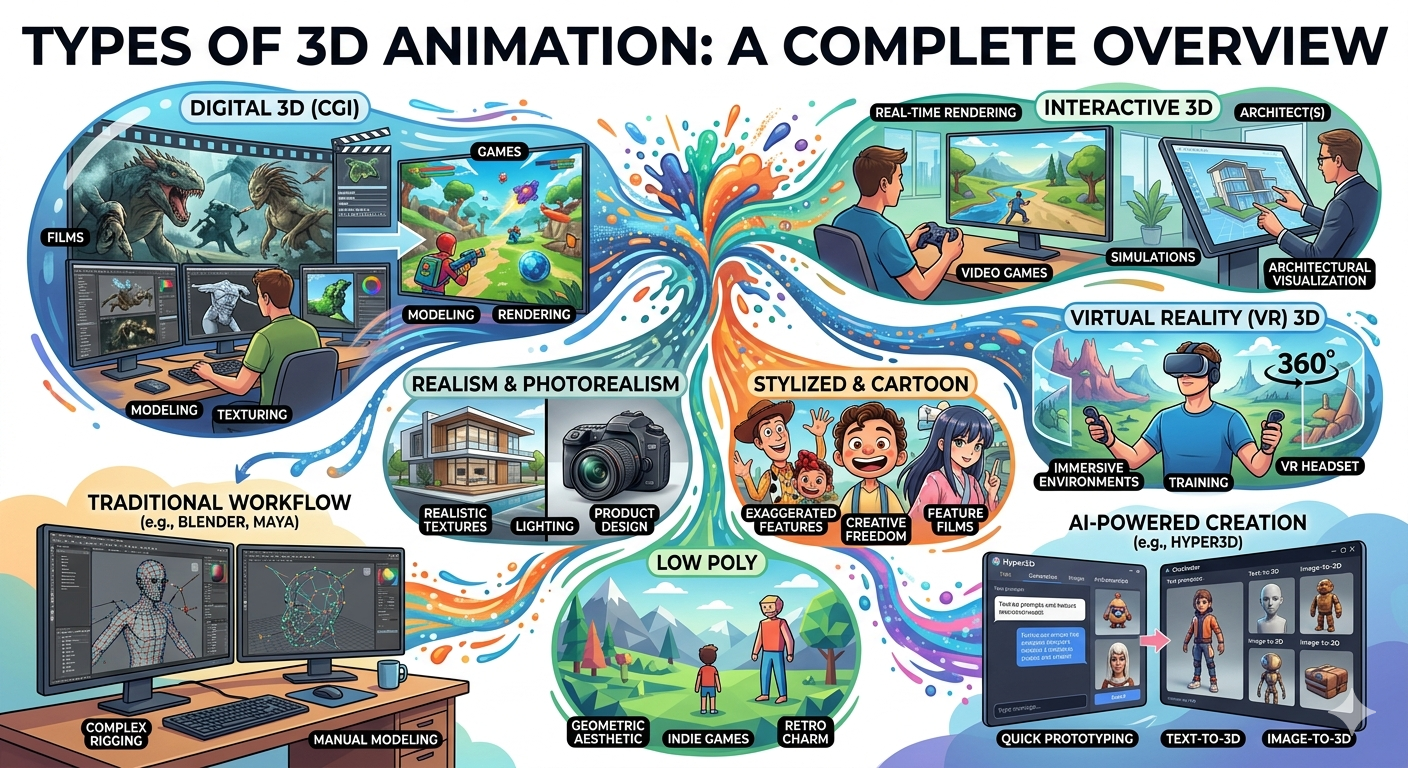
Digital 3D, or Computer-Generated Imagery (CGI), is the most common form of 3D animation. It involves modeling, texturing, and rendering 3D objects in a digital environment. This is the technique behind the stunning visual effects in Hollywood blockbusters and the immersive worlds of modern video games. The process starts with creating a 3D model, which is like a digital sculpture. This model is then given a surface texture and color. Finally, the scene is lit and rendered, which is the process of generating the final 2D image from the 3D scene. The different types of 3D animation all rely on this fundamental process in one way or another.
Interactive 3D
Interactive 3D takes the viewing experience a step further by allowing the user to interact with the 3D world. This is the core technology of video games, where players control characters and make decisions that affect the outcome of the story. It relies on real-time rendering, which means the images are generated on the fly, responding instantly to the player's actions. This is a key difference from pre-rendered animation used in films. Interactive 3D is also used in training simulations, allowing pilots to practice flying in a safe environment, and in architectural visualization, where clients can walk through a virtual building before it's constructed.
Virtual Reality (VR) 3D
Virtual Reality (VR) 3D takes interactivity to the next level by immersing the user in a completely digital environment. Using a VR headset, users can look around and move within the 3D world as if they were actually there. This creates a powerful sense of presence and is used for incredibly immersive games, training simulations for pilots and surgeons, and virtual social platforms. The hardware, which includes the headset and often hand controllers, tracks the user's movements to update the virtual world in real-time.
Exploring Different 3D Animation Art Styles
Beyond the technical methods, 3D animation also encompasses a variety of art styles that define the look and feel of the final product. The choice of art style is a creative decision that can dramatically impact the story being told.
Realism and Photorealism
The goal of realistic and photorealistic animation is to create visuals that are indistinguishable from real life. This style requires meticulous attention to detail in modeling, texturing, and lighting to mimic the way light behaves in the real world. It's often used in architectural visualization to show what a building will look like before it's built, in product design to create realistic renders for marketing, and in films for lifelike visual effects. Achieving photorealism is a technical and artistic challenge that pushes the boundaries of computer graphics.
Stylized and Cartoon
Stylized and cartoon animation intentionally departs from reality to create a unique visual language. This style gives artists the freedom to exaggerate features, play with colors, and create worlds that are not bound by the laws of physics. It's the style we see in most animated feature films and television shows, from the whimsical characters of Pixar to the action-packed worlds of anime. The possibilities are endless, allowing for a wide range of emotional expression and storytelling.
Low Poly
Low poly is an art style that uses a relatively small number of polygons to create 3D models. This results in a distinct, blocky, and often minimalist aesthetic. Originally a necessity due to hardware limitations, low poly has become a deliberate artistic choice. It's popular in indie games for its retro charm and is also used in art and illustrations for its clean and abstract look. The simplicity of low poly models also makes them efficient to render, which is a practical advantage.
My First-Hand Experience with 3D Animation Tools
Having spent years working with various 3D animation tools, I've had the chance to see the field from multiple angles. My journey began with Blender, a powerhouse of a tool that's completely free. The initial learning curve was like climbing a mountain, but the vast community and endless tutorials were my guides. I've also spent considerable time with Autodesk Maya, the go-to software for many professional studios. It has a certain polish and a set of specialized tools that make complex character rigging more manageable, but it comes at a premium price. Exploring the different types of 3D animation has been a fascinating journey.
Lately, my focus has shifted to the exciting world of AI-powered 3D creation, and Hyper3D has been a central part of that exploration. The AI 3D model generator is a completely different way of working. Instead of spending hours meticulously modeling, I can generate complex shapes and characters from a simple text description. The image to 3D feature is particularly impressive, turning 2D sketches into 3D assets almost instantly. For character work, ChatAvatar offers a quick way to generate a talking avatar from a single photograph. While the AI-generated models sometimes require a bit of cleanup, the speed and accessibility are a huge advantage. And for managing all these new assets, the 3D format converter is an essential utility for converting between formats like FBX and GLB for use in different applications.
Objective Comparison of 3D Animation Software
Choosing the right software depends on your goals, budget, and experience level. Here?? a look at some popular options:
| Tool | Best For | Pricing | Pros | Cons |
|---|---|---|---|---|
| Blender | General purpose 3D | Free | Incredibly powerful, huge community, open-source | Steep learning curve, can be overwhelming for beginners |
| Autodesk Maya | Professional film & game animation | Subscription | Industry standard, solid toolset, great for complex rigs | Expensive, steep learning curve |
| Cinema 4D | Motion graphics and visualization | Subscription | User-friendly interface, great integration with After Effects | Expensive, not as strong for character animation as Maya |
| Hyper3D | AI-powered generation and quick prototyping | Freemium | Very fast for generating models, easy to use, great for beginners | Less manual control, results can be unpredictable |
For someone just starting, I'd recommend Blender because it's free and has a massive amount of learning resources. If you're a professional animator, Maya is still the king for character work. For motion graphics artists, Cinema 4D is a fantastic choice. And if you want to quickly generate assets or prototypes without a lot of manual modeling, Hyper3D is a great option to explore.
FAQ about Types of 3D Animation
What is the most popular type of 3D animation?
Digital 3D, or CGI, is the most widespread and recognized type of 3D animation, used extensively in movies, television, and video games.
How long does it take to learn 3D animation?
Learning the basics can take a few months, but becoming proficient can take years of dedicated practice. The time it takes depends on the software you choose and the complexity of the animation you want to create.
What is the best software for beginners in 3D animation?
Blender is often recommended for beginners because it is free, open-source, and has a large and supportive community. AI-powered tools like Hyper3D can also be a great starting point for those who want to see results quickly.
Can I do 3D animation on my own?
Yes, many individuals create amazing 3D animations on their own. With powerful and accessible software, it's more possible than ever for solo artists to produce high-quality work.
What is the future of 3D animation?
Real-time rendering, AI-powered tools, and virtual reality are all shaping the future of 3D animation. We can expect to see more immersive, interactive, and intelligently generated content in the years to come.
Conclusion
From the realism of CGI to the creative freedom of stylized animation, the world of 3D animation is rich and varied. Understanding the different types of 3D animation and art styles is key to choosing the right approach for your project. The journey into 3D animation can be a long but rewarding one. It is a field that combines technical skill with artistic vision. Whether you're an aspiring animator looking to create your first short film, a game developer building immersive worlds, or a marketer looking to create engaging product visualizations, there is a type of 3D animation that is right for you. The tools are more accessible than ever, from powerful open-source software like Blender to innovative AI-powered platforms like Hyper3D. The possibilities are truly endless, and there has never been a more exciting time to dive in and start creating.