

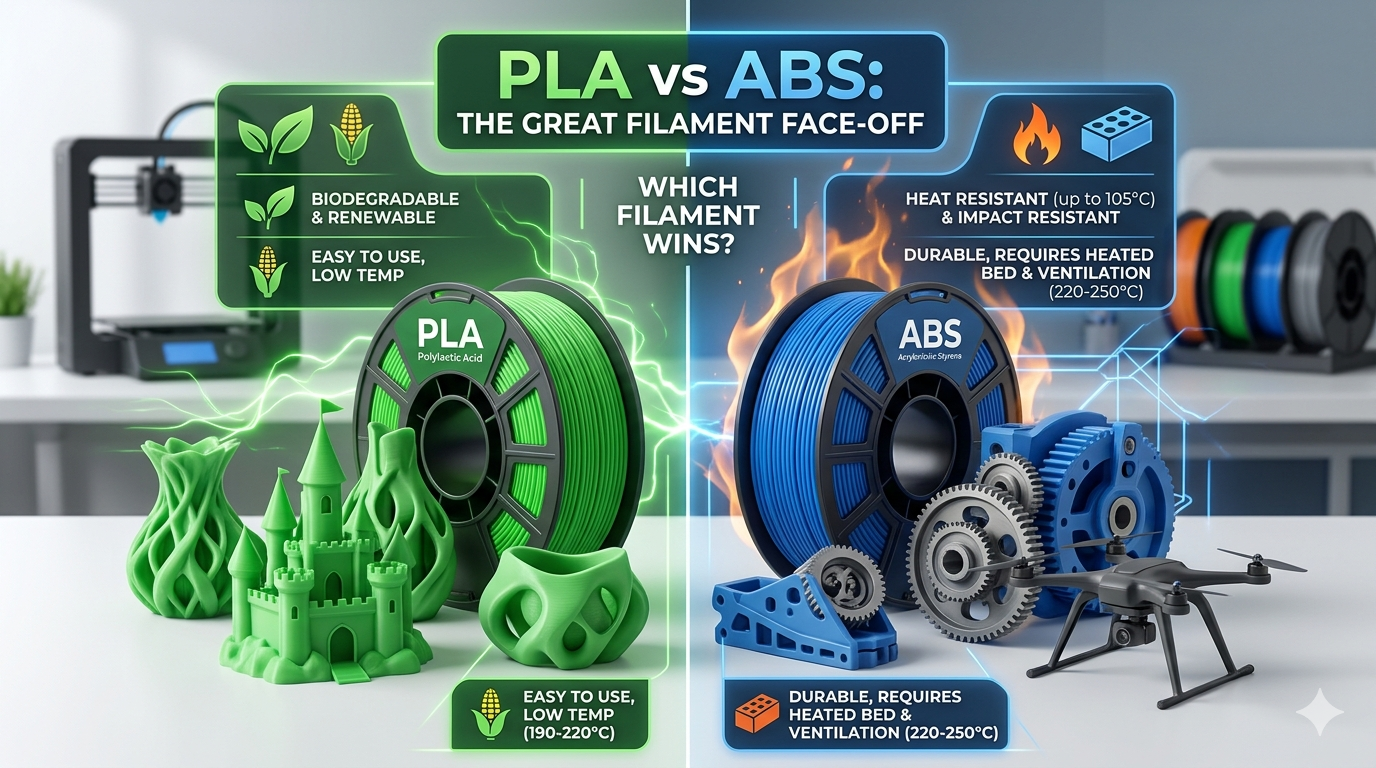
PLA vs ABS: Best Filament for 3D Printing
Choosing the right filament is a critical decision that can make or break your 3D printing project. Among the vast array of materials available, PLA and ABS have long stood out as two of the most popular choices for both hobbyists and professionals. While both are thermoplastics that are extruded to create 3D objects, they possess distinct characteristics that make them suitable for different applications. Whether you're creating a quick prototype with a 3D printing model generator or a durable functional part, understanding the differences between these two materials is essential.
This article provides a detailed comparison of PLA and ABS, examining their properties, printing requirements, and ideal use cases. This article will help you settle the PLA vs ABS debate for your 3D printing needs. We'll explore everything from strength and temperature resistance to ease of use and environmental impact, helping you make an informed decision for your next 3D printing endeavor.
What is PLA (Polylactic Acid)?
Polylactic Acid, or PLA, is a biodegradable thermoplastic derived from renewable resources such as cornstarch or sugarcane. This makes it a more environmentally friendly option compared to petroleum-based plastics. PLA is known for its ease of use, making it a popular choice for beginners in 3D printing. It prints at a lower temperature, doesn't require a heated bed, and is less prone to warping than ABS. You can use it with a wide range of 3D printers and even an image to STL converter to bring your 2D designs to life.
PLA is also prized for its ability to produce prints with a smooth, glossy finish and fine details. However, it's not the strongest or most heat-resistant filament. It has a low glass transition temperature, meaning it will start to soften and deform at temperatures around 60?C (140?F). This makes it unsuitable for objects that will be exposed to heat or significant mechanical stress.
What is ABS (Acrylonitrile Butadiene Styrene)?
Acrylonitrile Butadiene Styrene, or ABS, is a petroleum-based thermoplastic known for its strength, durability, and impact resistance. It's the same type of plastic used to make LEGO bricks, car parts, and electronic housings. ABS has a higher glass transition temperature than PLA, around 105?C (221?F), making it a better choice for applications where heat resistance is important.
However, ABS is more challenging to print with than PLA. It requires a heated print bed to prevent the print from warping and cracking as it cools. It also emits a strong, unpleasant odor during printing, so a well-ventilated area is a must. While it may not produce the same glossy finish as PLA, ABS parts can be easily post-processed. For example, they can be sanded or smoothed with acetone vapor to create a very smooth, professional-looking surface. For more complex models, you might consider using an AI 3D model generator to create your initial design before printing with ABS.
PLA vs ABS: A Head-to-Head Comparison in the Great PLA vs ABS Debate
To help you decide which filament is right for your project, here's a direct comparison of their key properties:
| Feature | PLA (Polylactic Acid) | ABS (Acrylonitrile Butadiene Styrene) |
|---|---|---|
| Strength & Durability | Stiffer and stronger in terms of tensile strength, but more brittle and prone to snapping under pressure. | Less stiff but more durable and impact-resistant. It can bend more before breaking. |
| Heat Resistance | Low heat resistance. Starts to deform at temperatures around 60?C (140?F). | High heat resistance. Can withstand temperatures up to 105?C (221?F). |
| Ease of Printing | Very easy to print. It has a lower printing temperature, doesn't require a heated bed, and is less prone to warping. | More difficult to print. It requires a heated bed and an enclosure to prevent warping and cracking. |
| Surface Finish | Typically has a smoother, glossier finish. | Can have a matte finish, but can be smoothed with acetone for a glossy look. |
| Odor | Emits a sweet, minimal odor during printing. | Emits a strong, unpleasant plastic odor during printing, requiring good ventilation. |
| Environmental Impact | Biodegradable and made from renewable resources. | Petroleum-based and not biodegradable, but it is recyclable. |
| Applications | Ideal for prototypes, decorative objects, and items not exposed to heat or stress. A great choice when using an image to 3D tool for quick visualization. | Best for functional parts, mechanical components, and items that need to be strong and heat-resistant. |
My First-Hand Experience: PLA vs ABS for a Custom Drone Part
To really understand the practical differences between PLA and ABS, I decided to put them to the test with a real-world project: creating a custom-designed landing gear for my drone. I started by using a 3D printing model generator to create the initial design. The process was straightforward, and I quickly had a 3D model ready for printing.
Printing with PLA
I first printed the landing gear using PLA. The printing process was incredibly smooth. I didn't have to worry about adjusting the print bed temperature, and there was no noticeable warping. The final print had a clean, slightly glossy finish, and the details were sharp. However, when I took the drone out for a test flight, the PLA landing gear didn't hold up well to a rough landing. It was too brittle and snapped on impact. This experience highlighted PLA's limitations for functional parts that need to withstand stress.
Printing with ABS
Next, I printed the same landing gear using ABS. This time, the printing process was more involved. I had to use a heated print bed and an enclosure to maintain a consistent temperature and prevent the part from warping. The smell was also quite strong, so I made sure to have my workshop well-ventilated. The final ABS print had a matte finish and wasn't as aesthetically pleasing as the PLA version right off the printer. However, the difference in durability was night and day. The ABS landing gear was much more flexible and absorbed the shock of a rough landing without any issues. It was clear that for this application, ABS was the superior material.
For those looking to convert existing 2D designs or images into 3D models for printing, an image to STL converter can be a great starting point. And if you're working with different 3D file formats, a 3D format converter can be an invaluable tool to ensure compatibility with your printer and software.
Frequently Asked Questions (FAQ)
In the PLA vs ABS debate, which is stronger?
This is a common question, and the answer depends on how you define "strong." PLA has a higher tensile strength, meaning it can withstand more pulling force before it breaks. However, it is also more brittle. ABS, on the other hand, has better impact strength and is more flexible, meaning it can absorb more energy before cracking. For parts that need to bend and flex without breaking, ABS is the stronger choice. For parts that need to be rigid and hold their shape under tension, PLA might be better.
Can you 3D print PLA without a heated bed?
Yes, one of the biggest advantages of PLA is that it can be printed without a heated bed. It has a lower printing temperature and is much less prone to warping than ABS. This makes it an ideal material for beginners and for use with a wider range of 3D printers, including many entry-level models.
Is ABS filament toxic to breathe?
ABS filament does release fumes during printing that can be irritating and potentially harmful to breathe in over long periods. It's made from petroleum and contains styrene, which is a known volatile organic compound (VOC). It is highly recommended to print with ABS in a well-ventilated area or to use an enclosure with a ventilation system to filter the air.
For beginners, what's the verdict on PLA vs ABS?
For beginners, PLA is almost always the recommended starting material. Its ease of use, low printing temperature, and forgiving nature make for a much smoother learning curve. You can achieve high-quality prints with minimal fuss, allowing you to focus on learning the basics of 3D printing without having to troubleshoot issues like warping and bed adhesion that are common with ABS.
What temperature should I print PLA vs ABS?
Printing temperatures can vary slightly depending on the specific filament brand and your 3D printer. However, a good starting point for PLA is around 190-220?C for the extruder and no heated bed required, though 50-60?C can help with adhesion. For ABS, you'll need a higher extruder temperature, typically in the range of 220-250?C, and a heated bed at 90-110?C is essential to prevent warping.
Conclusion: Choosing the Right Filament for Your Needs
Ultimately, the choice between PLA and ABS comes down to the specific requirements of your project. In the end, the PLA vs ABS decision is not about which is definitively better, but which is better for you. If you're creating visual prototypes, artistic models, or objects that won't be subjected to high temperatures or mechanical stress, PLA is an excellent choice. Its ease of use and high-quality finish make it a go-to material for a wide range of applications.
On the other hand, if you need to create functional parts that are strong, durable, and can withstand heat, ABS is the clear winner. While it may be more challenging to print with, the superior mechanical properties of ABS make it the ideal material for real-world applications. By understanding the strengths and weaknesses of each filament in the great PLA vs ABS face-off, you can select the perfect material for your next 3D printing project and bring your creations to life with confidence.