

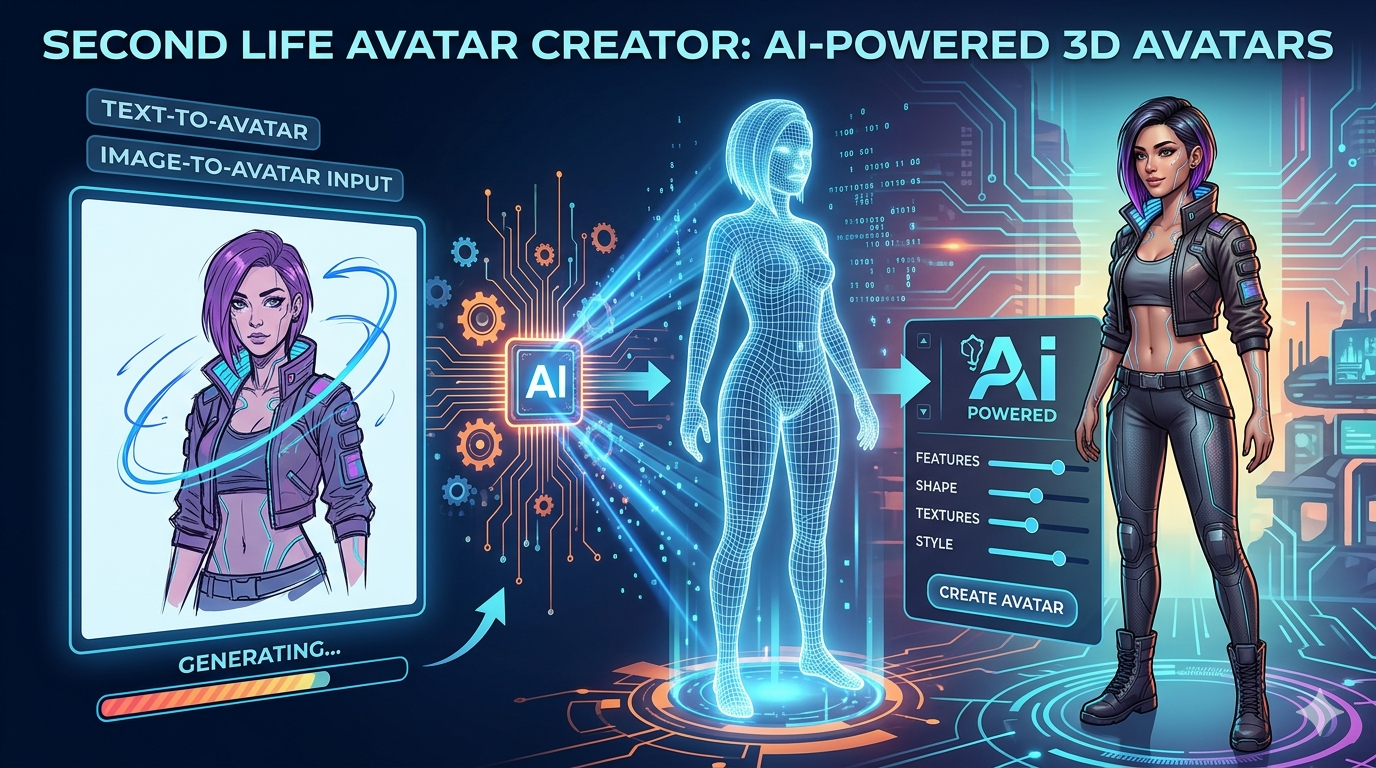
Second Life Avatar Creator: AI-Powered 3D Avatars
Second Life has been a cornerstone of the virtual world scene for nearly two decades, offering a sprawling digital universe where users can create, explore, and build communities. It’s a place of immense creative freedom, and at the very heart of this experience is the avatar—your digital self. The journey of crafting a unique online identity has evolved from basic, in-world customization to a sophisticated process involving a vibrant economy of third-party creators, making the Second Life avatar creator experience a central part of the platform. Now, a new force is reshaping this landscape: artificial intelligence. This article explores the exciting and dynamic world of the Second Life avatar creator, with a special focus on how AI is making custom avatar creation more accessible than ever before.
For many residents, their Second Life avatar is more than just a digital puppet; it's a form of self-expression, a piece of art, and a core part of their virtual identity. The desire for a unique look has fueled a massive marketplace, but the tools to create truly custom content from scratch have traditionally been complex and time-consuming. This is where AI-powered platforms are making a significant impact, offering a new path for both aspiring and established creators.
Understanding the Basics of Second Life Avatars
For newcomers, the journey begins with a starter avatar. These are system-provided models that, while functional, offer limited customization. They are the blank canvas upon which you build your virtual identity. The real magic of Second Life lies in personalization, and the community has built an entire economy around it.
The Importance of Mesh
To truly stand out, you’ll want to upgrade to a mesh body and head. These are 3D models created by third-party developers that offer far more realistic and detailed appearances than the classic, system-generated avatars. Mesh components are the foundation of a modern Second Life look, providing a higher level of detail in shape, shading, and movement. You can find an incredible variety of styles, from photorealistic human forms to fantastical creatures, furries, and robots.
The Role of the Marketplace
The Second Life Marketplace is the central hub for all things avatar-related, a true nexus for any Second Life avatar creator. It’s a sprawling online store where creators sell everything from mesh bodies and heads to clothing, accessories, animations, and skins. A skin is a texture that applies to your avatar's mesh, defining its surface appearance, including skin tone, makeup, and tattoos. The marketplace is a testament to the creativity of the Second Life community and the primary resource for anyone looking to customize their look.
The New Wave: AI in Avatar Creation
The traditional path to creating custom avatar content is a steep one. It requires expertise in 3D modeling software like Blender, ZBrush, or Maya, programs that can take years to master. This high barrier to entry has historically limited the number of people who can create and sell their own content. However, the rise of AI has introduced a new, more accessible path for aspiring creators.
AI-powered tools can generate 3D models from simple text prompts or images, opening up a world of possibilities. This technology dramatically lowers the skill floor, allowing anyone with a creative vision to bring it to life without needing to be a 3D modeling expert, a key feature of a modern Second Life avatar creator. Tools like Hyper3D's AI avatar creator and other platforms are making it easier than ever to design unique characters from scratch.
This technology not only speeds up the creation process but also allows for a level of creative freedom that was previously out of reach for many. You can experiment with different styles, features, and concepts in a fraction of the time it would take with traditional methods. This rapid iteration is a powerful tool for both new creators finding their style and established artists looking to streamline their workflow.
My First-Hand Experience with a Second Life Avatar Creator
To get a real sense of how these new AI tools perform, I decided to put one to the test. My goal was to create a unique, futuristic character with glowing cybernetic tattoos—a concept that would be challenging to create from scratch. I turned to an AI-powered platform to see if I could bring this vision to life.
I started with a text-to-3D generator, feeding it a detailed description: "A slender android with iridescent skin, sharp facial features, and intricate, glowing blue circuits running across the arms and back." Within a few minutes, the AI generated a base model. The result was impressive. It captured the overall aesthetic I was aiming for, providing a solid, well-proportioned foundation. The model was a bit rough, lacking the fine details I had imagined, but it was a fantastic starting point.
Next, I used an image-to-3D tool to refine the design. I created some simple 2D patterns for the cybernetic tattoos and uploaded them as reference images. The AI intelligently mapped these designs onto the 3D model, creating the intricate, glowing patterns I had envisioned. The process felt less like a technical task and more like a creative collaboration with a digital artist.
After a few more iterations to tweak the facial structure and smooth out the mesh, I had a 3D model that I was genuinely excited about. The final step was preparing it for Second Life. I used Hyper3D’s OmniCraft tool to convert the model to FBX, a format compatible with the Second Life viewer. The entire process, from a simple idea to a game-ready asset, took just a couple of hours. It was a powerful demonstration of how a Second Life avatar creator can accelerate the creative workflow.
AI vs. Traditional Methods: An Objective Comparison
Choosing between an AI-powered Second Life avatar creator and traditional 3D modeling depends entirely on your goals, skills, and available resources. Both paths have their own strengths and weaknesses, and the right choice for you will depend on your specific needs. Here’s a breakdown to help you decide:
| Feature | AI-Powered Creation | Traditional 3D Modeling |
|---|---|---|
| Skill Level | Beginner-friendly; no prior 3D experience needed. | Requires significant expertise in complex software. |
| Time Investment | Extremely fast, generating models in minutes to hours. | Very time-consuming, often taking days or weeks per asset. |
| Cost | Typically subscription-based, offering access to a suite of tools. | Can involve expensive software licenses and/or high fees for commissioned artists. |
| Creative Control | Offers high-level directional control, but less precision. | Provides fine-grained, absolute control over every vertex and polygon. |
| Uniqueness | Can sometimes produce generic results without careful refinement. | Results are highly unique and tailored to the artist's specific vision. |
For hobbyists, new creators, or anyone who wants to quickly prototype ideas, AI tools are an excellent choice. They remove the technical barriers and allow you to focus on the creative vision. Traditional methods, on the other hand, remain the standard for professional creators who require complete control over their work and aim to produce highly detailed, bespoke assets for sale on the marketplace.
Top Second Life Avatar Creator Tools Powered by AI
The landscape of AI-powered 3D creation is expanding at a breathtaking pace. Several platforms have emerged as powerful contenders for Second Life creators. Here are a few of the top tools that are making a mark:
Among the top contenders is Hyper3D, a platform that offers a comprehensive suite of tools for the entire 3D creation pipeline. With features like the character design generator, powerful text-to-3D with Rodin, and smooth format conversion with OmniCraft, it’s a solid option for Second Life creators. You can even bring your creative narratives to life with their innovative story tab.
Another popular choice is Meshy AI, which has gained a following for its user-friendly interface and impressive range of AI-powered 3D generation tools, including text-to-3D and image-to-3D. It is a favorite among many Second Life content creators for its ability to quickly generate high-quality base models.
Recognizing the power of AI, the creators of Second Life have also introduced their own native tool, Linden Lab's AI Character Designer. While still in its early alpha stages, this tool shows immense promise for a more integrated and smooth creation experience in the future.
FAQ: Your Second Life Avatar Questions Answered
How do I make my Second Life avatar look good?
Achieving a high-quality look in Second Life is a multi-step process. It starts with investing in a good quality mesh body and head from a reputable creator on the Marketplace. From there, you’ll want to find a well-made skin that complements your chosen mesh. Finally, the right clothing, hair, and accessories will complete your look. Don’t be afraid to experiment and mix and match items from different creators to develop your own unique style.
Can I create a Second Life avatar for free?
Absolutely. It is entirely possible to create a great-looking avatar without spending any real money. Many creators offer free or heavily discounted items, often called “group gifts,” to members of their in-world groups. There are also frequent sales and promotional events where you can find high-quality items for free or for a very low price. While the highest-end items will almost always come with a price tag, a bit of searching can yield a fantastic freebie wardrobe.
What are the best tools for creating a custom Second Life avatar?
For those with the skills and patience, traditional 3D modeling programs like Blender and ZBrush remain the industry standard for creating professional-grade assets. However, for a more accessible approach, AI-powered platforms like Hyper3D and Meshy AI are excellent choices for a Second Life avatar creator. They offer a much faster and more intuitive workflow for generating custom models.
How do I upload my own 3D model to Second Life?
To bring your own creation into Second Life, you first need to save it in a compatible format, such as DAE (Collada) or FBX. Once you have your file, you can use the Second Life viewer to upload it. Navigate to “Build > Upload > Mesh Model” to begin the import process. Be aware that there is a fee in Linden Dollars (L$) to upload a mesh model, and the cost is based on the complexity of the model. More complex models with higher polygon counts will cost more to upload.
What are the limitations of AI-generated avatars in Second Life?
While AI-generated models are a fantastic starting point, they are not always perfect right out of the box. They may require some manual cleanup and optimization to work flawlessly in Second Life. You might need to adjust the model’s topology, fix UV maps, or refine textures to meet the platform’s technical standards. Tools like Hyper3D's OmniCraft format converter can be invaluable for this part of the process, helping to ensure your model is optimized for the virtual world.
The Future of Virtual Identity
The world of the Second Life avatar creator is more exciting and accessible than it has ever been. AI is acting as a great equalizer, democratizing content creation and helping more people to bring their unique virtual identities to life. Whether you are a seasoned 3D artist looking to speed up your workflow or a complete beginner with a creative spark, there are now tools available to help you craft the perfect avatar with a Second Life avatar creator.
As this technology continues to advance, the line between the real and the virtual will only become more blurred. Our digital selves will become even more expressive, detailed, and unique. The fusion of human creativity and artificial intelligence is paving the way for a new golden age of virtual expression, and the avatars of Second Life are at the very forefront of this exciting new frontier.