

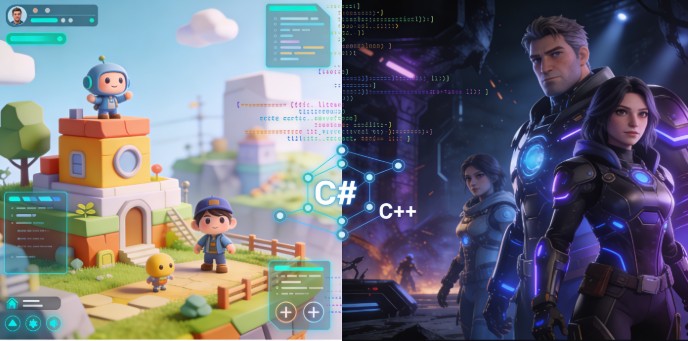
Unity vs Unreal Engine: Which Is Better for Your 3D Game?
Choosing the right game engine is one of the most critical decisions a developer makes. It impacts everything from workflow and performance to the final look and feel of your game. For years, two names have dominated the conversation: Unity and Unreal Engine. Both are powerful platforms for creating interactive experiences, from simple 2D mobile games to sprawling 3D worlds and immersive VR applications. This article provides an objective comparison in the ongoing unity vs unreal engine debate to help you decide which engine is the better fit for your next project.
Key Differences at a Glance
To understand the core distinctions between Unity and Unreal Engine, a side-by-side comparison is helpful. Each engine has its own philosophy and strengths, catering to different types of developers and projects.
| Feature | Unity | Unreal Engine |
|---|---|---|
| Developer | Unity Technologies | Epic Games |
| Primary Language | C# | C++ |
| Visual Scripting | Unity Visual Scripting | Blueprints |
| Best For | Indie, 2D, mobile, beginners | AAA 3D, cinematic visuals, multiplayer |
| Graphics Ceiling | High quality; less photorealistic than Unreal | Industry-leading, photorealistic |
| 2D Support | Excellent dedicated 2D toolset | Limited; primarily 3D-focused |
| Source Code | Closed source | Open source (full C++ access) |
| Pricing (2026) | Free tier available; paid plans from $185/yr | Free; 5% royalty on revenue over $1M |
| Learning Curve | Gentler, thanks to C# | Steeper; C++ requires more experience |
| Asset Marketplace | Unity Asset Store | Fab (formerly Unreal Marketplace) |
What is Unity?: Unity Vs Unreal Engine
Unity is a versatile and widely-used game engine known for its user-friendly interface and cross-platform capabilities. It empowers developers to create a vast range of games and interactive content, supporting over 25 platforms, including PC, mobile, consoles, and VR/AR devices. Its intuitive workflow makes it a popular choice for beginners and indie developers. The Unity Asset Store is a massive marketplace filled with pre-made assets, tools, and extensions that can significantly speed up development.
What is Unreal Engine?
Unreal Engine, developed by Epic Games, is synonymous with high-fidelity, photorealistic graphics. It is the engine behind many of the industry's most visually stunning AAA titles. Unreal's power comes from its advanced rendering features like Lumen for dynamic global illumination and Nanite for virtualized geometry, allowing for incredible detail and realism. While it has a steeper learning curve due to its C++ foundation, its Blueprint visual scripting system allows non-programmers to create complex game logic. The Fab marketplace offers a curated selection of high-quality assets for developers.
Unity vs Unreal Engine: A Deeper Dive
Beyond the high-level differences, the choice in the great unity vs unreal engine debate often comes down to the specific needs of your project.
Graphics and Visuals
When it comes to raw graphical power, Unreal Engine has a distinct edge. Games like *Fortnite* and *The Matrix Awakens* showcase its ability to render breathtakingly realistic environments and characters. Unity can still produce beautiful, high-quality graphics, as seen in titles like *Genshin Impact* and *Hollow Knight*, but achieving the same level of photorealism as Unreal requires more effort and technical expertise.
Performance and Programming
Unity's primary programming language is C#, which is generally considered easier to learn and use than C++. This makes Unity a more approachable option for those new to coding. Unreal Engine uses C++, a powerful language that offers more low-level control over memory and performance but comes with a steeper learning curve. However, Unreal's Blueprint system is a solid visual scripting tool that enables developers to build entire games without writing a single line of code, making it accessible to artists and designers.
2D Game Development
For 2D game development, Unity is the clear winner. It offers a dedicated suite of 2D tools, including a sprite editor, a 2D physics engine, and tilemap functionality. This makes it an ideal choice for creating side-scrollers, puzzle games, and other 2D genres. While it's possible to create 2D games in Unreal, the engine is fundamentally designed for 3D, and its 2D toolset is less mature.
Pricing and Licensing
Both engines offer free tiers for individuals and small teams. Unity's pricing is based on a subscription model, with different tiers (Personal, Pro, Enterprise) unlocking additional features and support. As of Unity 6, the controversial runtime fee has been removed. Unreal Engine uses a royalty-based model: it's free to use until your game earns over $1 million in gross revenue, at which point Epic Games takes a 5% royalty. This royalty is waived if you publish your game on the Epic Games Store.
Community and Support
Both engines have large, active communities. Unity's community is particularly strong among indie developers and hobbyists, with a wealth of tutorials, forums, and documentation available online. Unreal's community is also solid, with a strong presence in the AAA and film industries. Both offer extensive learning resources to help developers get started.
My First-Hand Experience
To get a feel for both sides of the unity vs unreal engine coin, I decided to build a simple 3D scene in each. I started by creating a basic environment and importing some assets. I used a game 3D model generator to create a few simple props. The process of getting assets into both engines was straightforward. I did run into an issue with file formats, but a quick search led me to an FBX to OBJ converter that solved the problem. In Unity, the component-based architecture felt very natural. I could quickly assemble objects and attach scripts to define their behavior. The asset store was a huge time-saver, providing a wealth of ready-made models and textures. Setting up a basic scene with lighting and post-processing effects was straightforward, and I had a playable prototype running in just a few hours. The iteration time was fast, which is a massive plus for experimentation.
Switching to Unreal Engine, the difference in visual fidelity was immediately apparent. The default lighting setup with Lumen created a much more dynamic and realistic scene from the get-go. The material editor, while complex, offered an incredible amount of power and control over the look of my assets. I spent a good amount of time just playing with the node-based materials to create interesting visual effects. While the initial learning curve was steeper, especially when navigating the more extensive editor, the payoff in visual quality was undeniable. For a solo developer, the Blueprint system felt like a superpower, allowing me to implement complex logic without deep C++ knowledge.
Objective Comparison: Which Should You Choose?
The unity vs unreal engine choice is not just about features, but also about philosophy. Unity prioritizes flexibility and ease of use, making it an incredibly versatile tool for a wide range of applications. Unreal, on the other hand, is focused on pushing the boundaries of what's possible in real-time graphics. Ultimately, the best engine for you depends on your goals, experience, and project requirements. Here?? a more detailed breakdown to help you decide:
Choose Unity if:
- You are a beginner or new to programming.
- You are making a 2D or mobile game.
- You need to prototype ideas quickly.
- You are working on a project that needs to be deployed on a wide range of platforms.
Choose Unreal Engine if:
- You are aiming for AAA-quality, photorealistic graphics.
- You are working on a large-scale 3D project.
- You want access to the full C++ source code for deep customization.
- You are creating cinematic content or architectural visualizations.
FAQ
Is Unity or Unreal better for beginners?
Unity is generally considered better for beginners due to its easier-to-learn C# programming language and more intuitive interface.
Is Unreal Engine really free?
Yes, Unreal Engine is free to use. You only pay a 5% royalty on your game's gross revenue after it has earned more than $1 million.
Which engine is better for mobile games?
Unity has historically been the preferred choice for mobile game development due to its strong performance on a wide range of devices and its extensive optimization tools.
Do AAA studios use Unity?
Yes, many AAA studios use Unity, especially for mobile games and titles that don't require the highest level of graphical fidelity. *Genshin Impact* is a prime example of a successful AAA game made with Unity.
Can I use Unreal Engine without knowing C++?
Absolutely. Unreal's Blueprint visual scripting system is powerful enough to create complete games without writing any C++ code. Many successful indie games have been built entirely with Blueprints. However, for large-scale projects or performance-critical systems, a combination of Blueprints and C++ is often the most effective approach.
Which engine has a better asset store?
Unity's Asset Store is significantly larger and more diverse, offering a vast selection of assets at various price points. This makes it a great resource for indie developers and those on a tight budget. Unreal's Fab marketplace is smaller but tends to have a higher bar for quality, with a focus on production-ready assets for high-end projects.
How important is the choice of engine for getting a job?
Both Unity and Unreal are in high demand in the game industry. Unreal Engine is more prevalent in AAA studios, especially for roles focused on graphics programming and high-fidelity art. Unity is widely used in mobile, AR/VR, and indie game development. Having experience with both engines will make you a more versatile and marketable candidate.
Conclusion
The unity vs unreal engine debate is not about which engine is definitively better, but which is the right tool for the job. This is the core of the unity vs unreal engine discussion. Both are incredibly capable platforms that have been used to create some of the most successful games of all time. As you embark on your game development journey, consider your project's scope, your team's skills, and your ultimate vision. And for developers looking to streamline their asset creation pipeline, tools like Hyper3D's AI 3D model generator, image to 3D converter, and 3D format converter can be invaluable resources, regardless of which engine you choose.