

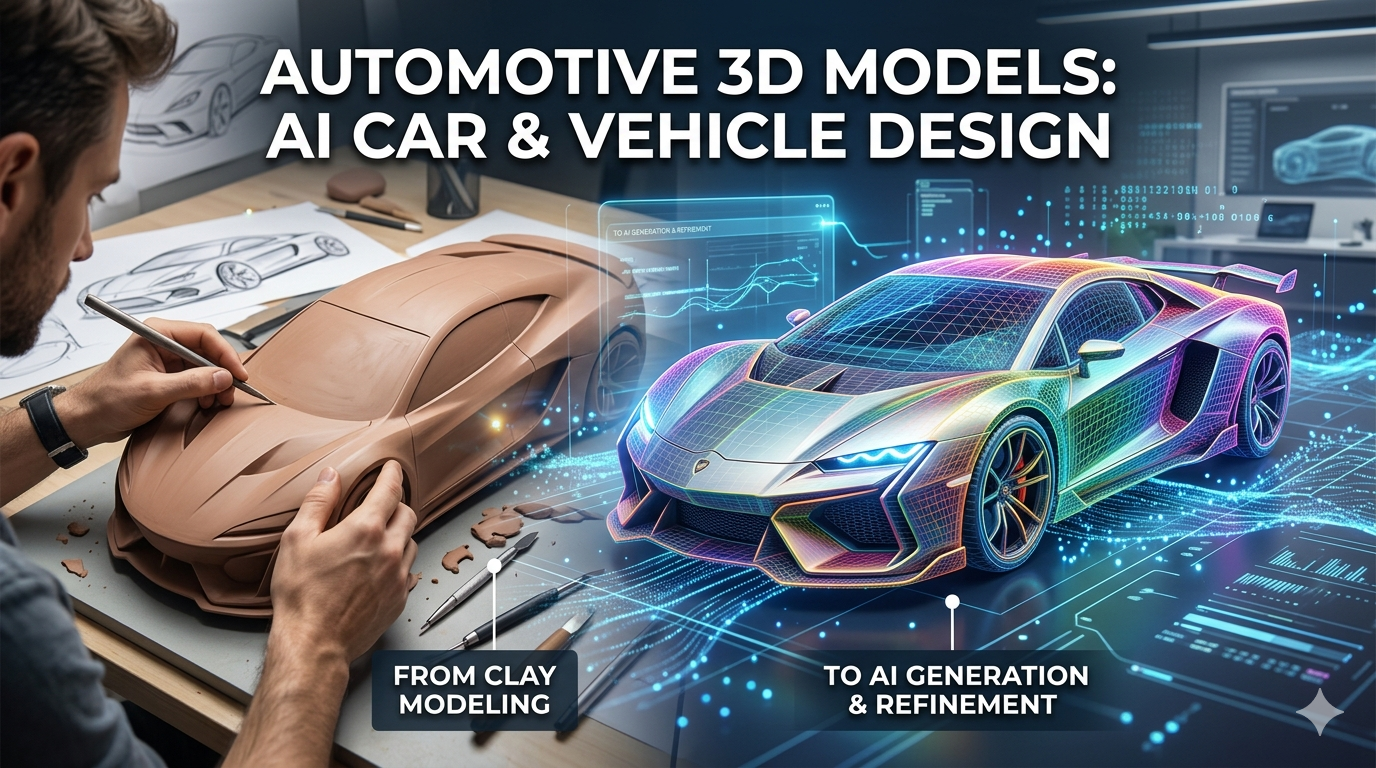
Automotive 3D Models: AI Car & Vehicle Design
The world of automotive design is undergoing a significant transformation. For decades, designers relied on clay models and painstaking manual adjustments to bring their visions to life. Today, digital tools have taken center stage, and more recently, artificial intelligence is steering the industry in a bold new direction. AI-powered platforms are making it possible to generate, refine, and visualize car designs with unprecedented speed and creativity. While established software like Autodesk Alias and open-source options like Blender have long been part of the designer's toolkit, new AI-native tools like Hyper3D's automotive 3D generator are introducing fresh possibilities.
The Evolution of Automotive Design: From Clay Models to AI
Traditional Automotive Design Processes
Not so long ago, the automotive design process was a hands-on affair. Designers would sketch their ideas on paper, and then skilled sculptors would translate those 2D drawings into full-scale clay models. This process, while effective, was time-consuming and expensive. Every iteration required manual adjustments to the clay, making it a slow and laborious path from concept to showroom.
The Digital Revolution in Car Design
The advent of computer-aided design (CAD) software marked a major turning point for the industry. Digital tools allowed designers to create and modify their designs in a virtual environment, dramatically speeding up the iteration process. This shift to digital workflows enabled more complex and aerodynamic shapes, and it laid the groundwork for the next leap forward.
The Rise of AI in Automotive 3D Design
Now, we're in the midst of another shift, this time driven by artificial intelligence. AI is not just a tool for speeding up existing workflows; it's a creative partner that can generate novel design concepts from simple text prompts or images. An AI 3D generator can produce a wide array of design options in minutes, allowing designers to explore a much broader creative landscape than ever before. This technology is democratizing design, making it more accessible to a wider range of creators.
Top AI-Powered Automotive 3D Design Tools
Hyper3D: The AI 3D Generator for Automotive Design
Hyper3D is leading the way of the AI design movement. Its suite of tools, including the ability to convert both images to 3D and text to 3D models, offers a new way to approach automotive design. Instead of starting from scratch, designers can use AI to generate initial concepts and then refine them using traditional modeling techniques. This hybrid approach combines the creative spark of AI with the precision of human craftsmanship.
Blender: The Open-Source Powerhouse
Blender has long been a favorite among 3D artists for its flexibility and powerful feature set. While not an AI-native tool, its open-source nature and extensive community support have led to the development of numerous add-ons that incorporate AI-powered features. For designers on a budget or those who value a high degree of customization, Blender remains a top contender for automotive 3D design.
Autodesk Alias: The Industry Standard
For decades, Autodesk Alias has been the go-to software for professional automotive designers. It's known for its high-quality surface modeling capabilities, which are essential for creating the smooth, flowing lines of a modern car. While Alias is a powerful and precise tool, it also comes with a steep learning curve and a high price tag, making it best suited for established design studios.
Other Notable Tools
Beyond these three, there are many other tools that can be used for automotive 3D design. 3ds Max is another Autodesk product that is widely used for visualization and rendering, while SelfCAD offers a more user-friendly, browser-based modeling experience.
My First-Hand Experience with an Automotive 3D Generator
I was curious to see how an AI-powered tool would handle a real-world design task, so I decided to take Hyper3D's automotive 3D generator for a spin. I started with a simple text prompt: "a futuristic electric sports car with aggressive lines and a low profile." Within a few minutes, the AI had generated a series of concepts. Some were a bit outlandish, but a few showed real promise.
I selected one of the more interesting designs and used Hyper3D's editing tools to refine it. I adjusted the proportions, tweaked the shape of the headlights, and experimented with different wheel designs. The process felt more like a collaboration than a one-way street. The AI provided the initial inspiration, and I used my design sensibilities to shape it into a more polished concept. The ability to quickly generate and modify ideas was a refreshing change from the more methodical pace of traditional modeling.
Objective Comparison of Automotive 3D Design Tools
To give you a better sense of how these tools stack up, here?? a side-by-side comparison:
| Feature | Hyper3D | Blender | Autodesk Alias |
|---|---|---|---|
| Primary Use | AI-powered concept generation | General-purpose 3D modeling and animation | Professional surface modeling for automotive design |
| Ease of Use | Very easy to learn | Moderate learning curve | Steep learning curve |
| Pricing | Freemium model with paid tiers | Free and open-source | Expensive subscription |
| Target Audience | Designers of all levels, from hobbyists to professionals | 3D artists, animators, and indie game developers | Professional automotive designers and large design studios |
| Pros | Rapid idea generation, intuitive interface | Highly flexible and customizable, large community | Industry-standard for Class-A surfacing, precise and powerful |
| Cons | Less precise than traditional modeling tools | Can be overwhelming for beginners | Very expensive, steep learning curve |
Ultimately, the best tool for the job depends on your specific needs. If you??e looking for a fast and easy way to generate new ideas, Hyper3D is an excellent choice. If you need a powerful and flexible tool for a wide range of 3D tasks, Blender is hard to beat. And if you??e a professional automotive designer who needs the best possible surface quality, Autodesk Alias is the industry standard for a reason.
The Future of Automotive 3D Design
The world of automotive 3D design is constantly evolving. We??e already seeing the impact of real-time ray tracing, which allows designers to create photorealistic renderings of their designs in an instant. Virtual reality is also playing an increasingly important role, allowing designers to experience their creations in a fully immersive 3D environment. Looking ahead, we can expect to see even more integration of AI and generative design, where algorithms will be able to create highly optimized and innovative vehicle concepts with minimal human input.
FAQ about Automotive 3D Design
What is the best software for car design?
There?? no single ??est??software for car design. It really depends on your budget, skill level, and specific needs. For beginners and those who want to quickly generate ideas, an AI 3D generator like Hyper3D is a great starting point. For more experienced users who need a full-featured modeling suite, Blender is a powerful and free option. For professionals, Autodesk Alias remains the industry standard.
How long does it take to learn automotive 3D design?
The learning curve for automotive 3D design can vary widely depending on the software you choose. AI-powered tools like Hyper3D can be learned in a matter of hours, while more complex programs like Blender or Autodesk Alias can take months or even years to master.
Can I 3D print a car model I design?
Yes, you can! Most 3D modeling software allows you to export your designs as STL or OBJ files, which are the standard formats for 3D printing. With a 3D printer, you can create physical prototypes of your car designs, which is a great way to test their form and function.
What are the benefits of using AI in car design?
AI offers a number of benefits for car design. It can rapidly generate a wide range of design concepts, helping designers to overcome creative blocks and explore new ideas. It can also be used to optimize designs for factors like aerodynamics and weight, leading to more efficient and better-performing vehicles.
How much does automotive design software cost?
The cost of automotive design software can range from free to tens of thousands of dollars per year. Open-source software like Blender is completely free, while professional-grade tools like Autodesk Alias can be very expensive. AI-powered tools like Hyper3D typically offer a freemium model, with a free tier for basic use and paid tiers for more advanced features.
Conclusion
The world of automotive design is more exciting and dynamic than ever before. The rise of AI-powered tools is democratizing design, making it more accessible to a wider range of creators and enabling a new level of creativity and innovation. Whether you??e a seasoned professional or just starting, there?? never been a better time to get involved in automotive 3D design. With tools like Hyper3D's image to 3D and text to 3D model generators, the only limit is your imagination.