

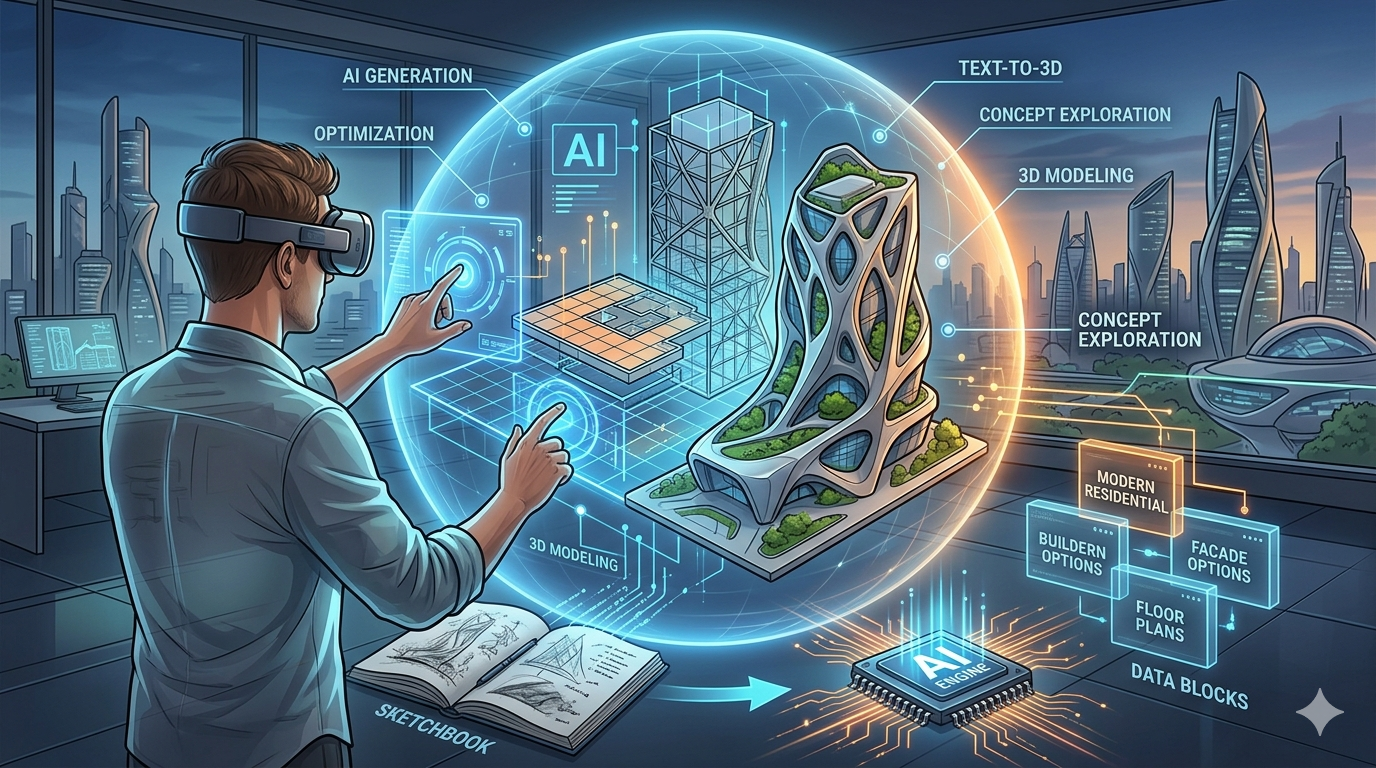
AI Architecture Design: Generate 3D Building Models
Artificial intelligence is changing how architects work, moving from initial sketches to detailed 3D models. Tools like Midjourney, Architechtures.com, and Hyper3D's own AI architecture design tool are becoming more common in the design process. These platforms help architects explore new ideas, automate repetitive tasks, and create visualizations more efficiently. This shift allows designers to focus more on the creative aspects of their work while the software handles some of the heavy lifting.
This article explores the practical applications of AI in architecture. We will look at how different tools can be used for everything from early-stage concept generation to creating detailed 3D building models. I'll also share my own experience using some of these tools and offer an objective look at their strengths and weaknesses. Whether you're a seasoned architect or just starting, understanding how to work with AI is becoming an important part of the job.
The Rise of AI in Architectural Design
For centuries, architectural design has been a manual process, relying on hand-drawn sketches and detailed blueprints. The digital age brought computer-aided design (CAD) software, which was a significant leap forward. Now, artificial intelligence is introducing another major shift. The use of AI in architectural design isn't about replacing the architect but augmenting their abilities. It can handle time-consuming tasks, allowing designers to focus on creative problem-solving and innovation.
AI algorithms can analyze vast amounts of data, from building codes and material properties to environmental factors and client preferences. This allows for the rapid generation of multiple design options that are already optimized for various constraints. For example, an AI can produce several floor plans for a residential building that all meet specific size requirements and local regulations. This frees up the architect to refine the best option rather than starting from scratch each time. The result is a more efficient workflow and the ability to explore a wider range of design possibilities, making AI architecture design an invaluable asset.
From Concept to Creation: AI-Powered Design Tools
AI-powered tools are now available for nearly every stage of the AI architecture design process, from the initial spark of an idea to the final 3D model. These tools can be broadly categorized based on their primary function.
Conceptual Design with AI
In the early stages of a project, the focus is on exploring broad ideas and visual styles. This is where text-to-image and image-to-image AI generators shine. Architects can use tools like Midjourney or Leonardo.ai to quickly visualize concepts. By providing a simple text prompt, such as "a modern residential tower with a green facade in a dense urban environment," designers can get a variety of visual interpretations in seconds. This is incredibly useful for brainstorming sessions and for communicating initial ideas to clients. You can also use an existing image as a starting point and have the AI generate variations, which is helpful for refining a concept.
Generative Design for Building Optimization
Once a general concept is established, the next step is to develop a more detailed design. Generative design tools, such as Architechtures.com, use AI to create optimized building layouts. These platforms can take a set of parameters??ike the number of units, desired room sizes, and site constraints??nd generate a complete building design that meets those criteria. The AI can even factor in things like structural integrity and energy efficiency. This is particularly useful for large-scale residential or commercial projects where there are many competing requirements to balance. The architect can then take the AI-generated design and refine it further, adding their own creative touch.
3D Model Generation
The final step in the design process is often the creation of a detailed 3D model. This is where tools like Hyper3D's architecture 3D generator come in. These platforms can take a 2D floor plan, a sketch, or even a text description and generate a fully-realized 3D model. This is a massive time-saver compared to traditional 3D modeling software. With a tool like Hyper3D, you can quickly create a model that can be used for client presentations, virtual reality walkthroughs, or even for 3D printing. The ability to go from a simple idea to a tangible 3D model so quickly is one of the most powerful applications of AI in architecture today. You can even convert your existing models with a 3D format converter.
My First-Hand Experience with AI Architecture Design Tools
To get a better sense of how these tools work in practice, I decided to try out Hyper3D's AI architecture design tool to generate a 3D model of a modern house. I started with a simple text prompt: "a two-story modern house with large windows and a flat roof." I was immediately presented with several design variations, each with a slightly different take on the concept. I chose the one that best matched my vision and moved on to the next step.
From there, I was able to refine the design using the platform's editing tools. I experimented with different generation modes, like 'Focal' to get more detailed results and 'Speedy' for quicker iterations. The ability to switch between modes was helpful for balancing quality and speed. I also tested the image to 3D feature by uploading a reference image of a facade I liked, and the AI incorporated elements of it into my model. The process felt intuitive, and I was able to make significant changes to the design without needing to be a 3D modeling expert.
Once I was happy with the model, I explored the export options. Hyper3D supports a variety of formats, including STL, FBX, OBJ, GLB, and USDZ, which makes it easy to import the model into other software for further refinement or for use in a game engine. I downloaded the model as a GLB file to view it in a web-based 3D viewer. The entire process, from the initial text prompt to having a downloadable 3D model, took less than an hour. It's easy to see how a tool like this could dramatically speed up the early stages of the design process.
Objective Comparison of AI Architecture Design Tools
There are a growing number of AI tools available for architects, each with its own strengths and weaknesses. Here?? a comparison of a few popular options:
| Tool | Pros | Cons | Best For |
|---|---|---|---|
| Hyper3D | Excellent for generating 3D models from text or images. Supports a wide range of export formats. Offers various generation modes for different needs. Includes a full suite of tools, from a text to 3D model generator to an AI texture generator. | Can be less focused on strict architectural standards and building codes. | Quickly creating 3D models for visualization and conceptual design. |
| Leonardo.ai | Great for generating high-quality 2D concept images. Offers a lot of control over the visual style. | Primarily a 2D tool; does not generate 3D models directly. | Brainstorming and creating beautiful concept art and architectural visualizations. |
| Architechtures.com | Focuses on generative design for residential buildings. Optimizes for building codes and other constraints. Generates BIM models. | Less focused on aesthetic exploration and more on optimization. The interface can be complex. | Architects and developers working on large-scale residential projects who need to optimize for specific criteria. |
Ultimately, the best tool for the job depends on your specific needs. If you're looking to quickly generate 3D models for visualization, Hyper3D is a great choice. If your focus is on creating stunning 2D concept art, Leonardo.ai is a powerful option. And if you're working on a large residential project and need to optimize for a variety of constraints, Architechtures.com is a specialized tool that can save you a lot of time.
The Future of AI in Architecture
The integration of AI architecture design is still in its early stages, but the potential is enormous. We can expect to see AI become even more deeply embedded in the design process in the coming years. This will likely include more advanced generative design tools that can optimize for an even wider range of factors, from sustainability and material usage to cost and construction time. We may also see AI play a larger role in the construction process itself, with AI-powered robots and drones helping to build the structures that architects design.
Another exciting area of development is the use of AI for real-time collaboration. Imagine a future where an architect, an engineer, and a client can all be in a shared virtual space, making changes to a 3D model of a building and seeing the impact of those changes instantly. AI could act as an intelligent assistant in this process, providing feedback and suggestions in real-time. While there are still challenges to overcome, the future of AI in architecture is bright, and it promises to make the design and construction of our built environment more efficient, innovative, and sustainable.
Frequently Asked Questions (FAQ)
What is AI architecture design?
AI architecture design refers to the use of artificial intelligence to assist in the process of designing buildings and other structures. This can include everything from generating initial design concepts to creating detailed 3D models and optimizing building performance. It's not about replacing architects, but rather providing them with powerful new tools to enhance their creativity and efficiency.
How can AI help with building design?
AI can help with building design in many ways. It can automate repetitive tasks, generate multiple design options based on a set of constraints, optimize for factors like energy efficiency and structural integrity, and create realistic visualizations and 3D models. This allows architects to explore more ideas in less time and make more informed design decisions.
What are the best AI tools for architects?
The best AI tools for architects depend on the specific task. For conceptual design and visualization, tools like Midjourney and Leonardo.ai are popular. For generative design and optimization, platforms like Architechtures.com are a good choice. And for quickly creating 3D models, Hyper3D's AI architecture design tool is a powerful option. Many architects use a combination of these tools in their workflow.
Can I generate a 3D model of a building using AI?
Yes, you can. Tools like Hyper3D allow you to generate a 3D model of a building from a simple text description or by uploading a 2D image. You can then refine the model and export it in a variety of formats for use in other software. This is a much faster way to create 3D models compared to traditional modeling methods.
Is AI going to replace architects?
No, it is highly unlikely that AI will replace architects. While AI can automate many tasks, it cannot replicate the creativity, critical thinking, and problem-solving skills of a human architect. AI is best thought of as a powerful tool that can augment an architect's abilities, freeing them up to focus on the more strategic and creative aspects of their work. The future of architecture is likely to be a collaboration between humans and AI.
Conclusion
Artificial intelligence is no longer a futuristic concept in architecture; it's a practical tool that is being used today to design better buildings, faster. From generating initial concepts to creating detailed 3D models, AI is streamlining the design process and helping architects to be more creative and innovative. While there are many different AI tools available, each with its own strengths, platforms like Hyper3D's AI architecture design tool and interior design 3D generator are making it easier than ever to go from an idea to a fully-realized 3D model. The same principles can be applied to smaller scales with an interior design 3D generator.
As AI technology continues to evolve, we can expect to see even more powerful and intuitive tools become available. The architects who embrace these new technologies will be the ones who are best positioned to succeed in the years to come. If you're ready to explore the possibilities of AI in your own work, I encourage you to try out some of the tools mentioned in this article and see what you can create. You can start your journey with Hyper3D's AI 3D model generator and see where your imagination takes you.