3D Printer Filament Types: PLA vs ABS vs PETG Explained
Choosing the right material is one of the most critical decisions in 3D printing. The filament you select will determine the strength, flexibility, and durability of your final print. While there are many options available, most makers find themselves choosing between three main 3D printer filament types: PLA, ABS, and PETG. Understanding the differences between them is key to achieving the results you want. Whether you're using a professional 3D printing model generator or a simple image to STL converter, the filament you choose will have a significant impact on your project's success.
Understanding PLA Filament
Polylactic Acid, or PLA, is one of the most popular 3D printer filament types, especially for beginners. It's a biodegradable thermoplastic derived from renewable resources like corn starch or sugarcane. This makes it a more environmentally friendly option compared to other plastics.
Properties of PLA
PLA is known for its ease of use. It has a relatively low printing temperature, typically between 190?C and 220?C, and it doesn't require a heated print bed. This makes it compatible with a wide range of 3D printers. Prints made from PLA have a slightly glossy finish and can be produced in a vast array of colors. However, PLA is also quite brittle and has low heat resistance, making it unsuitable for parts that need to withstand high temperatures or significant stress.
Pros and Cons of PLA
Pros:
- Easy to print with, great for beginners
- Low printing temperature and no heated bed required
- Minimal warping and shrinking
- Biodegradable and made from renewable resources
- Wide variety of colors available
Cons:
- Brittle and not very strong
- Low heat resistance, can deform in direct sunlight
- Not suitable for functional parts that require durability
Exploring ABS Filament
Acrylonitrile Butadiene Styrene, or ABS, is another common choice among 3D printer filament types. It's the same type of plastic used to make LEGO bricks, so you know it's tough. ABS is known for its strength, durability, and high heat resistance, making it a great choice for functional parts.
Properties of ABS
ABS requires higher printing temperatures than PLA, typically between 220?C and 250?C. It also needs a heated print bed to prevent the print from warping as it cools. One of the main drawbacks of printing with ABS is that it releases a strong, unpleasant odor and potentially harmful fumes, so a well-ventilated area is a must. The finished prints are strong, slightly flexible, and can be sanded and smoothed with acetone for a glossy, professional finish.
Pros and Cons of ABS
Pros:
- Strong, durable, and impact-resistant
- High heat resistance
- Can be post-processed with acetone for a smooth finish
Cons:
- More difficult to print with than PLA
- Requires a heated print bed and an enclosure is recommended
- Emits strong fumes during printing
- Prone to warping and cracking
Getting to Know PETG Filament
PETG, or Polyethylene Terephthalate Glycol, is a popular alternative to both PLA and ABS. It's a modified version of PET, the plastic used to make water bottles. PETG offers a good balance of properties, combining the ease of printing of PLA with the strength and durability of ABS.
Properties of PETG
PETG prints at temperatures between 220?C and 250?C, and while a heated bed is recommended, it's not always necessary. It has excellent layer adhesion, resulting in strong, durable prints with a glossy finish. PETG is also more flexible than PLA and less prone to warping than ABS. However, it can be prone to stringing and requires some fine-tuning of printer settings to get the best results.
Pros and Cons of PETG
Pros:
- Strong, durable, and more flexible than PLA
- Good chemical and heat resistance
- Low shrinkage and warping
- Food-safe (check manufacturer's specifications)
Cons:
- Prone to stringing and oozing
- Can be more difficult to dial in the perfect print settings
- More expensive than PLA and ABS
PLA vs. ABS vs. PETG: A Head-to-Head Comparison
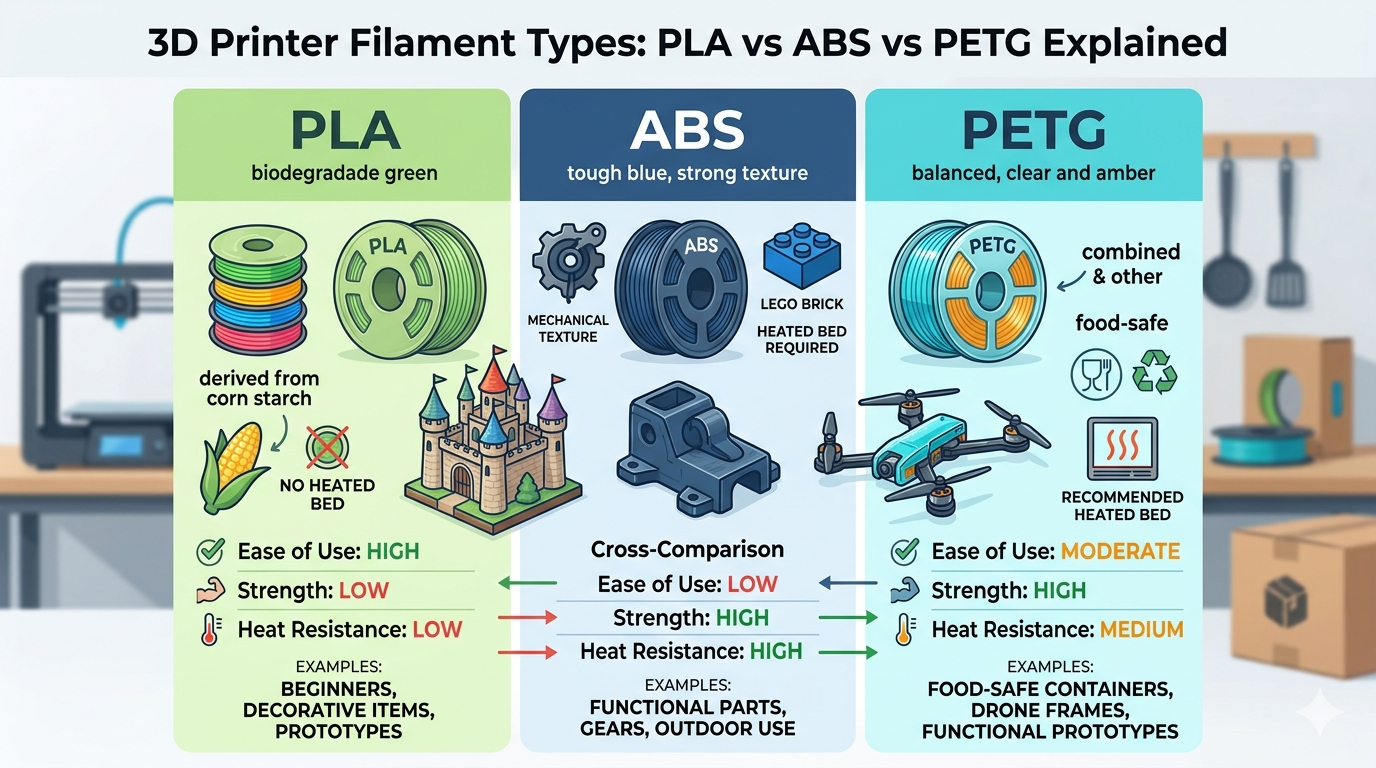
To help you decide which of these 3D printer filament types is right for your project, here's a direct comparison of their key properties:
| Property | PLA | ABS | PETG |
|---|---|---|---|
| Ease of Use | Easiest | Difficult | Moderate |
| Strength | Low | High | High |
| Durability | Low | High | High |
| Heat Resistance | Low | High | Medium |
| Flexibility | Low | Medium | Medium |
| Printing Temp. | 190-220?C | 220-250?C | 220-250?C |
| Heated Bed | Not required | Required | Recommended |
| Fumes | Minimal | Strong | Minimal |
When to use each filament:
- PLA: Best for beginners, decorative objects, and prototypes that don't require high strength or heat resistance.
- ABS: Ideal for functional parts, mechanical components, and items that need to withstand stress and high temperatures.
- PETG: A great all-rounder for functional prototypes, mechanical parts, and food-safe containers.
My First-Hand Experience with 3D Printer Filament Types
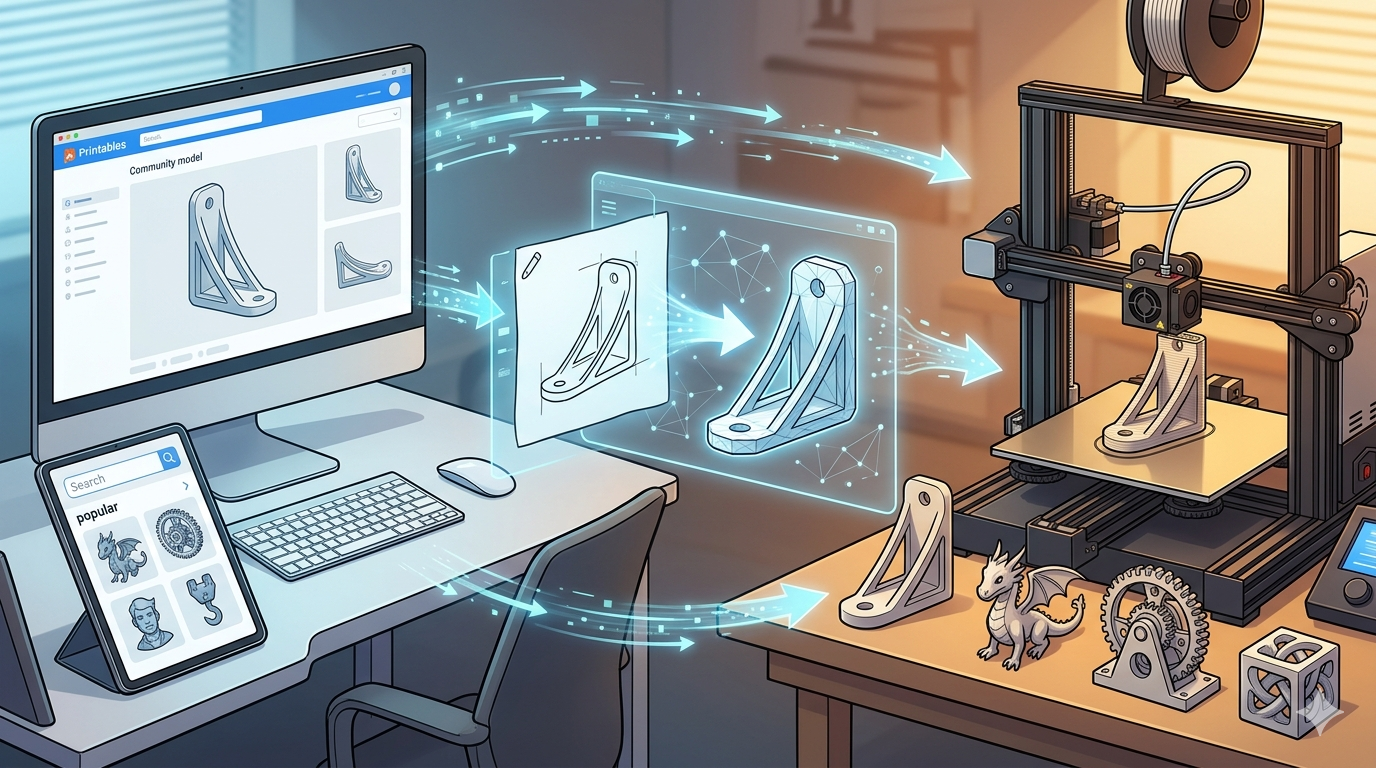
I recently worked on a project where I needed to create a custom phone stand. I started by using an AI 3D model generator to design the basic shape. The tool was intuitive and allowed me to quickly generate a 3D model from a simple text prompt. For the first print, I chose PLA because I wanted to quickly prototype the design and check the fit. The print came out perfectly, but I knew the stand needed to be more durable for everyday use.
Next, I decided to try turning a 2D logo into a 3D emblem for the stand. I used an image to 3D tool, which did a fantastic job of converting the flat image into a printable model. For the final version of the phone stand, I switched to PETG. It was a bit trickier to get the print settings just right, but the end result was a strong, durable stand with a beautiful glossy finish. The PETG provided the strength I needed without the printing difficulties of ABS. For converting the final model to the right format, a 3D format converter can be very helpful.
Other Common 3D Printer Filament Types
While PLA, ABS, and PETG are the most common, there are many other 3D printer filament types to explore. TPU is a flexible, rubber-like filament perfect for creating things like phone cases or flexible joints. Nylon is another strong and durable option, often used for engineering applications. There are also specialty filaments that are filled with materials like wood, metal, or carbon fiber to create unique finishes and properties.
Frequently Asked Questions (FAQ)
What is the easiest filament to print with?
PLA is by far the easiest filament to print with. It has a low printing temperature, doesn't require a heated bed, and is very forgiving of less-than-perfect print settings. This makes it the ideal choice for anyone new to 3D printing.
Which filament is the strongest?
When it comes to strength and durability, ABS is generally considered the strongest of the three main filament types. However, PETG is also very strong and offers a good balance of strength and ease of printing.
Can I use any filament with my 3D printer?
Most modern 3D printers can handle PLA, ABS, and PETG. However, it's always a good idea to check your printer's specifications. Some printers may not have a heated bed, which is necessary for printing with ABS. Others may have a maximum extruder temperature that is too low for some materials.
What is the best filament for outdoor use?
For outdoor applications, you'll want a filament that is resistant to UV light and temperature changes. ASA (Acrylonitrile Styrene Acrylate) is an excellent choice for outdoor use, as it's essentially a UV-resistant version of ABS. PETG can also be a good option, but it may become brittle over time with prolonged sun exposure.
How should I store my 3D printer filaments?
It's important to store your filaments properly to maintain their quality. Most filaments are hygroscopic, meaning they absorb moisture from the air. This can lead to poor print quality and even clogs in your printer's nozzle. Store your filament in a cool, dry place, preferably in a sealed container with a desiccant pack to keep it dry.
Choosing the right filament is a key step in the 3D printing process. By understanding the differences between the main 3D printer filament types, you can select the best material for your project and achieve amazing results. Whether you're creating a simple model or a complex functional part, there's a filament out there that's perfect for the job.
In my experience, the choice between these filaments often comes down to the specific application. For purely decorative items, PLA is almost always the best choice. It?? forgiving, comes in a huge range of colors, and produces beautiful prints with minimal effort. I once printed a detailed miniature castle in PLA, and the fine details were rendered perfectly. However, when I tried to use that same castle as a decorative piece in my car, it warped into an unrecognizable blob on the first hot day.
For a more practical project, I needed to print a replacement part for my dishwasher rack. The original part had broken due to the high heat and moisture. I knew PLA wouldn't work, so I turned to ABS. Printing with ABS was a challenge. I had to build a simple enclosure around my printer to maintain a consistent temperature and prevent warping. The fumes were also quite strong, so I had to move the printer to my garage. But the final part was incredibly strong and has held up perfectly in the dishwasher for months.
PETG has become my go-to filament for most functional prints. It offers a great compromise between the ease of printing of PLA and the strength of ABS. I recently used it to print a custom-designed drone frame. The frame needed to be lightweight but also strong enough to survive the inevitable crashes. PETG was the perfect material for the job. It was relatively easy to print, and the final frame is incredibly durable. It has survived several hard landings with only a few minor scratches.
Expanding Your Filament Horizons
Beyond the big three, a whole world of specialized filaments awaits. Flexible filaments like TPU and TPE are perfect for creating items that need to bend and stretch, like phone cases or wearable gadgets. Composite filaments, which are filled with particles of other materials, offer unique properties. Wood-filled filaments can be sanded and stained to look like real wood, while metal-filled filaments can be polished to a metallic shine. There are even conductive filaments that can be used to create simple electronic circuits. Experimenting with these different 3D printer filament types can open up a whole new range of possibilities for your projects.
Conclusion
In the ever-evolving world of 3D printing, understanding the nuances of different 3D printer filament types is essential. While PLA, ABS, and PETG will cover most of your printing needs, don't be afraid to explore the vast and exciting world of specialty filaments. Each material has its own unique set of properties, and the more you understand about them, the better equipped you'll be to bring your creative visions to life. So, the next time you fire up your 3D printer, take a moment to consider which filament is the best tool for the job. Your future self will thank you for it.