

# What Is 3D Printing? How It Works Explained
3D printing, also known as additive manufacturing, is a process that creates a physical object from a digital design. Instead of carving a shape out of a solid block of material, a 3D printer builds the object layer by layer. This technology, which answers the question of what is 3d printing, has become increasingly popular in recent years, with applications ranging from rapid prototyping in the aerospace industry to creating custom jewelry at home. A variety of tools are available to get started, from traditional CAD software to newer platforms like an AI 3D model generator that can create models from text prompts or images.
The Fundamentals of 3D Printing: From Digital to Physical: What Is 3D Printing
The journey from an idea to a physical object in your hands involves a few key steps. It starts with a digital model, which is then sliced into thin layers and sent to the printer to be built one layer at a time. This process of what is 3d printing is becoming more accessible to everyone.
Creating the Blueprint: 3D Modeling: What Is 3D Printing
Every 3D print begins with a 3D model, which is a digital blueprint of the final object. There are several ways to create a 3D model. For those with a technical background, Computer-Aided Design (CAD) software offers precise control over every aspect of the design. Programs like AutoCAD and SolidWorks are industry standards for engineers and architects. However, for those who are new to 3D modeling or want to create something quickly, there are more accessible options available. 3D scanning is another method, where a real-world object is scanned to create a digital replica. But perhaps the most exciting development in recent years is the emergence of AI-powered tools. You can use an image to 3D tool to convert a 2D picture into a three-dimensional model, or even use a 3D printing model generator to generate a design from a simple text description. This has opened up the world of 3D printing to a much wider audience.
Slicing: Preparing the Model for the Printer
Once you have your 3D model, you need to prepare it for the printer. This is done using a special piece of software called a slicer. The slicer takes your 3D model and "slices" it into hundreds or even thousands of thin, horizontal layers. The slicer then generates the machine code, usually in a format called G-code, that tells the 3D printer exactly how to move and where to deposit material for each layer. You can also use the slicer to adjust a variety of settings that will affect the quality and strength of the final print. These settings include the layer height (thinner layers mean a smoother surface but a longer print time), the printing speed, and the infill density (the amount of material used inside the object, which affects its strength and weight).
The Additive Process: Building Layer by Layer
With the sliced file loaded, the 3D printer begins the building process. It reads the G-code and starts to build the object layer by layer, from the bottom up. The specific method of building varies depending on the type of 3D printing technology being used, but the fundamental principle of adding material in successive layers remains the same. This additive process is what makes 3D printing so versatile and efficient, allowing for the creation of complex geometries that would be difficult or impossible to produce with traditional manufacturing methods, such as subtractive manufacturing where material is removed from a solid block.
An Overview of Common 3D Printing Technologies
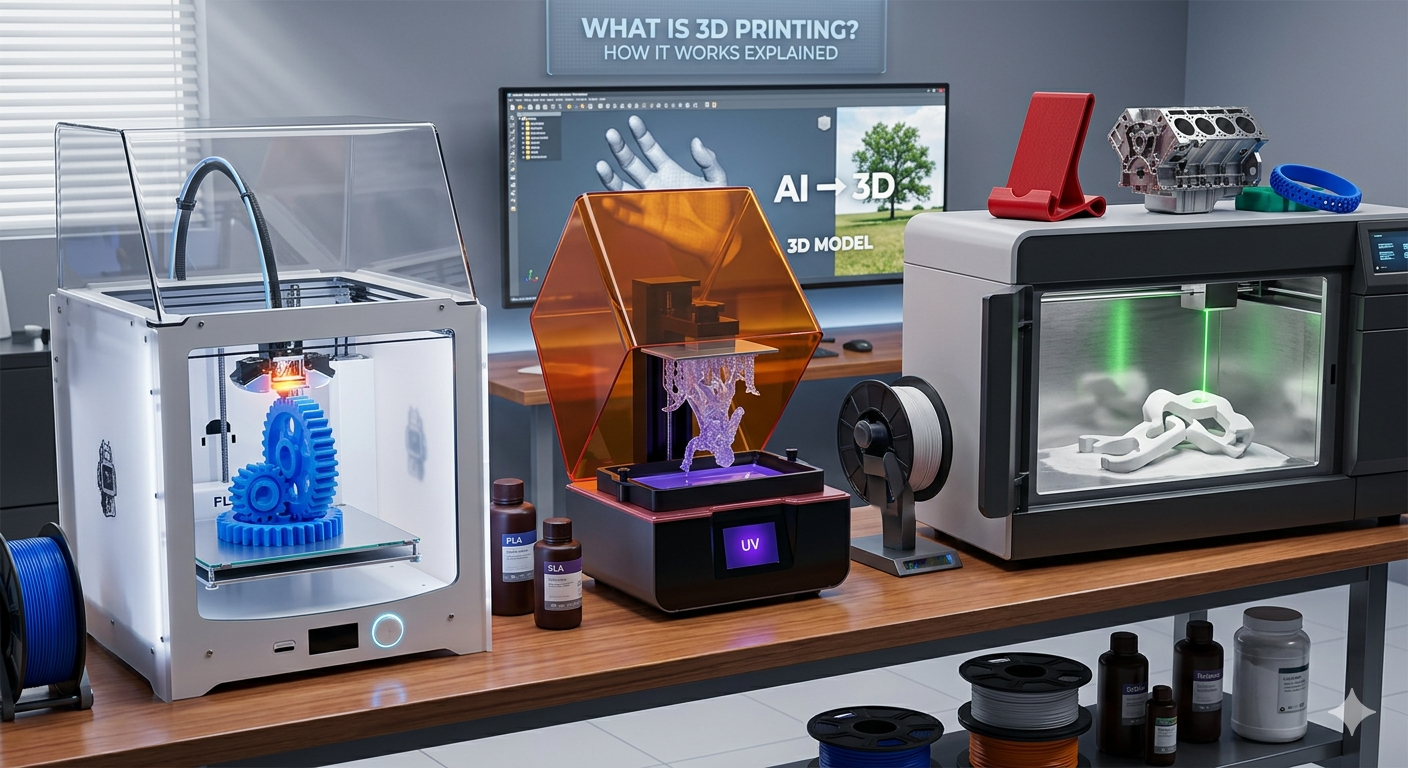
There are many different types of 3D printing technologies, each with its own strengths and weaknesses. The most common technologies you'll encounter are Fused Deposition Modeling (FDM), Stereolithography (SLA), and Selective Laser Sintering (SLS). Understanding what is 3d printing involves knowing about these different methods.
Fused Deposition Modeling (FDM): The Most Common Method
FDM is the most common and affordable type of 3D printing, and it's likely the technology you'll encounter if you buy a desktop 3D printer. FDM printers work by melting a plastic filament and extruding it through a nozzle, building the object layer by layer. It's a straightforward process that is great for producing functional prototypes, and custom parts. The range of materials available for FDM is also quite broad, including common plastics like PLA (Polylactic Acid) and ABS (Acrylonitrile Butadiene Styrene), as well as more durable materials like PETG (Polyethylene Terephthalate Glycol) and TPU (Thermoplastic Polyurethane). While FDM printers are relatively inexpensive and easy to use, they do have some limitations. The layer-by-layer process can result in visible layer lines on the final object, and the resolution is not as high as with other technologies.
Stereolithography (SLA): For High-Resolution Prints
SLA is one of the oldest forms of 3D printing and is known for producing high-resolution parts with a smooth surface finish. SLA printers use an ultraviolet (UV) laser to cure a liquid resin, solidifying it layer by layer to create the object. This technology is ideal for creating detailed and intricate objects, such as jewelry, dental models, and character miniatures. While the materials can be more expensive and the post-processing can be a bit messy (it involves washing the print in a solvent and then curing it under UV light), the level of detail is unmatched by FDM. The parts produced with SLA are also generally more brittle than those made with FDM.
Selective Laser Sintering (SLS): For Strong, Functional Parts
SLS is an industrial 3D printing technology that uses a high-powered laser to fuse together small particles of polymer powder. Because the unfused powder supports the object during the printing process, SLS can create complex and interlocking parts without the need for support structures. This makes it a great choice for producing durable, functional parts with a high degree of design freedom. SLS is often used in the aerospace and automotive industries for creating lightweight and strong components. However, SLS printers are expensive and require a dedicated space with good ventilation, so they are not typically found in homes or small businesses.
My First-Hand Experience with 3D Printing
To get a better understanding of what is 3d printing, I decided to create a custom phone stand. I started by using a 3D printing model generator to get a basic design. I simply typed in "a sleek, modern phone stand with a cable holder," and the AI generated a few different options for me. I chose a design that I liked and then decided to personalize it. I used an image to STL converter to add a small logo to the front of the stand. The process was surprisingly simple. The most impressive part was how easy it was to go from a simple idea to a printable file without any prior experience in 3D modeling. For those who want to create more complex models, there are also tools like an AI 3D model generator that can generate models from text prompts. Once I had my STL file, I used a 3D format converter to ensure it was compatible with my printer. The final step was to send the file to the printer and watch it come to life. The entire process, from idea to physical object, took only a few hours.
A Quick Comparison of 3D Printing Technologies
| Technology | Pros | Cons |
|---|---|---|
| FDM | Affordable, wide range of materials, easy to use | Lower resolution, visible layer lines |
| SLA | High resolution, smooth surface finish, great for details | More expensive, messy post-processing, materials can be brittle |
| SLS | High strength and durability, complex geometries without supports | Expensive, requires a dedicated space, limited material options |
Frequently Asked Questions About 3D Printing
What is the difference between 3D printing and additive manufacturing?
3D printing and additive manufacturing are often used interchangeably, but "additive manufacturing" is the more formal, industrial term for the technology. "3D printing" is the more common term used by consumers and hobbyists. When someone asks "what is 3d printing?", they are generally referring to the same process as additive manufacturing.
What materials can be used for 3D printing?
A wide variety of materials can be used for 3D printing, including plastics (like PLA, ABS, and PETG), resins, metals (like aluminum, stainless steel, and titanium), and even food (like chocolate and pasta). The specific material you can use will depend on the type of 3D printer you have. There are also specialized materials available, such as flexible filaments and wood-infused filaments.
How much does a 3D printer cost?
The cost of a 3D printer can range from a few hundred dollars for a basic FDM printer to tens of thousands of dollars for an industrial-grade SLS machine. The price of a printer depends on a variety of factors, including the technology it uses, the build volume, and the features it offers. For those who are just getting started, there are many affordable options available that are perfect for home use.
Is 3D printing difficult to learn?
3D printing has become much more accessible in recent years, and there are many resources available to help you get started. With tools like AI 3D model generators and image to 3D converters, you can create printable models without any prior experience in 3D modeling. There is also a large and active community of 3D printing enthusiasts online who are always willing to help newcomers.
What can I make with a 3D printer?
You can make almost anything you can imagine with a 3D printer, from custom phone cases and board game pieces to functional prototypes and replacement parts for household appliances. The possibilities are endless when you understand what is 3d printing. People have used 3D printers to create everything from custom-fit shoes to entire houses. As the technology continues to evolve, the range of applications for 3D printing will only continue to grow.