AI 아이소메트릭 3D 모델 생성기

Generate buildings, props, and tiles built for the isometric camera: compact footprints, readable rooflines, consistent scale. Export GLB or render to sprites.
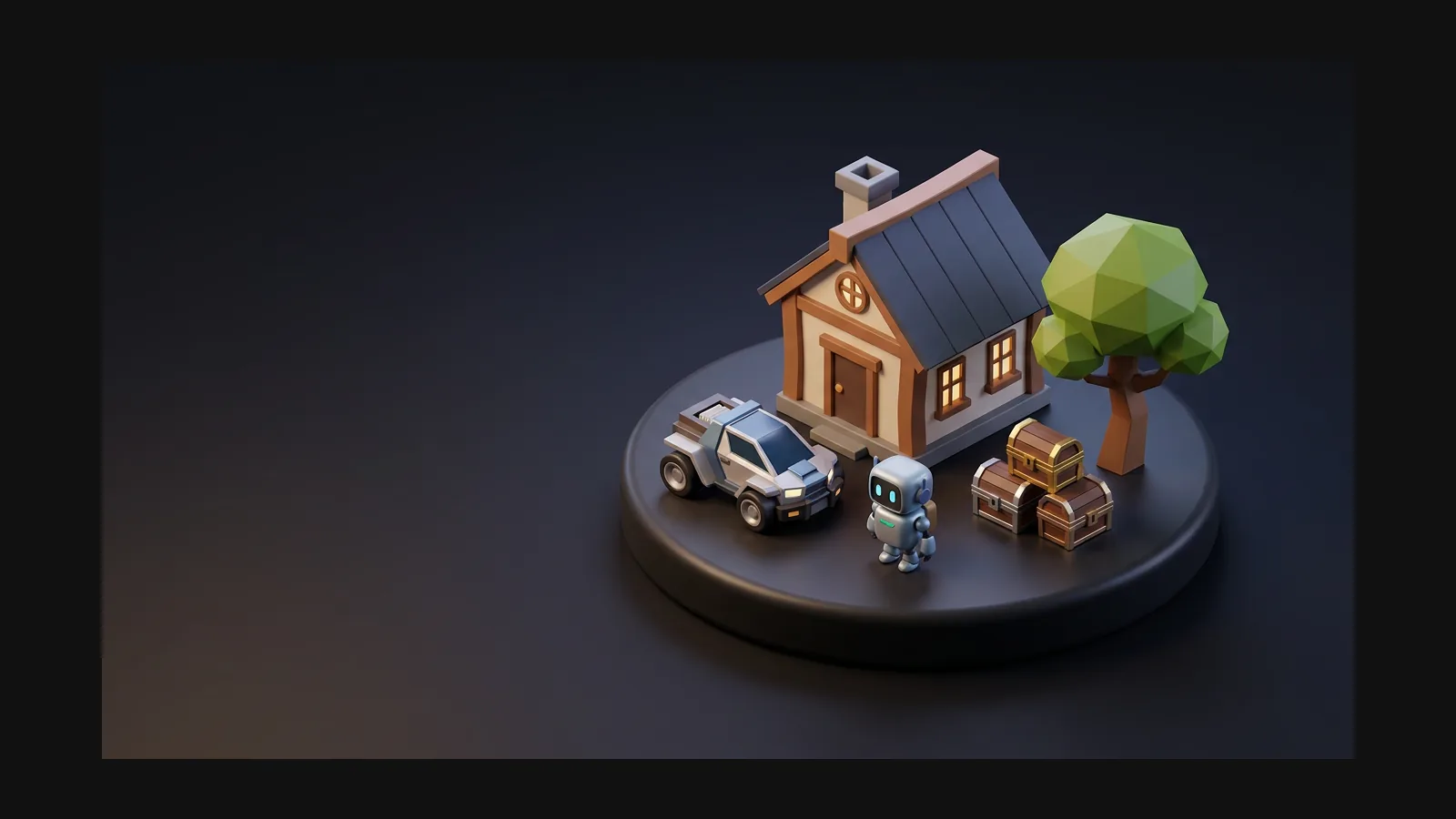
아이소메트릭 3D model generator hero image

아이소메트릭 에셋이 성립하는 조건

Four habits from city-builder and strategy art teams — camera, footprint, visible faces, scale — each one promptable and checkable before export.

카메라가 곧 스타일

카메라가 곧 스타일

Isometric is a viewpoint, not a material: an orthographic camera looking down at roughly 30 degrees, no perspective convergence. Any well-built 3D model becomes isometric the moment that camera points at it — which is exactly why generating real 3D beats drawing each angle by hand.

타일 친화적 풋프린트

타일 친화적 풋프린트

Game tiles live on a grid, so the model's base must respect it. Prompt for 'compact square footprint' or 'fits a single tile', and keep overhangs — awnings, roof eaves — inside the cell or deliberately one cell deep. That discipline is what makes a set snap together in a tilemap.

보이는 세 면을 위한 디자인

보이는 세 면을 위한 디자인

Rodin reasonably infers surfaces not visible in a single reference image; prompts can emphasize priorities based on creative intent without excluding hidden-surface details in advance.

전체 세트에서 일관되게 유지되는 안정적인 실제 세계 스케일

전체 세트에서 일관되게 유지되는 안정적인 실제 세계 스케일

Rodin generates nearly ready-to-use 3D models at a stable real-world scale, helping assets stay coherent across a city block. OmniCraft is a separate, optional toolkit for creative resizing when a particular scene or presentation scale is desired.

아이소메트릭 타일 세트 만들기

From one prompt to a district: generate, normalize, then either keep it 3D or render it down to sprites.

  1. Step 1 — Generate the anchor
    Grid of generated 3D building models for an isometric tile set

    One building sets the rules

    Rodin supports fixed seeds, reproducible results, and consistent asset generation. Shared references and style controls are optional ways to further direct a series.

    anchor prompt · palette lock
  2. Step 2 — Extend the set
    Generated isometric building model displayed at a stable real-world scale in the OmniCraft Mesh Editor

    Create Consistent Variations

    Rodin supports fixed seeds, reproducible results, and consistent asset generation at a stable real-world scale. Shared references and style controls are optional ways to further direct a cohesive series.

    image reference · consistent scale
  3. Step 3 — Ship 3D or sprites
    Textured 3D model viewed in a real-time engine with an orthographic isometric camera setup

    Two endings, both standard

    True-3D route: export GLB or FBX and set an orthographic camera at 30 degrees in Unity, Godot, or Unreal. Sprite route: render each model at the classic 2:1 dimetric angle in Blender and feed the PNGs to your 2D tilemap.

    GLB · FBX · 2:1 sprite renders

자 없이 그리는 아이소메트릭 일러스트

Tech-blog headers, product cutaways, explainer scenes: generate the room or device once, orbit to the exact angle, and render. Change the layout next week without redrawing a single line — the 3D scene is the source file.

이미지→3D 사용해보기
이미지→3D 사용해보기

아이소메트릭 3D 모델 생성기 FAQ

Camera angles, tile consistency, sprite rendering, and export formats — answered the way a strategy-game art lead would.

What is an isometric 3D model, exactly?

Strictly speaking, isometric is a projection — a camera convention, not a property of the mesh. In practice, "isometric 3D model" means an asset designed to look right under that camera: compact footprint, detail on the visible faces, proportions that read at a steep angle. Rodin generates the asset; your renderer supplies the projection.

True isometric or 2:1 dimetric — does it matter for my game?

It matters for pixel alignment, not for the model. True isometric uses equal 120-degree axes (~35.26° camera pitch); most 2D games actually use 2:1 dimetric (~26.57°) because tile edges land on whole pixels. The good news: the same 3D model serves both — it's just a camera angle you set at render time.

Does Rodin render the isometric view for me?

Rodin generates the 3D model; the fixed-angle render is a one-time setup in your tool of choice. In Blender: orthographic camera, rotation X 60°, Z 45°, done. In Unity or Godot: an orthographic camera at the matching pitch. Export GLB to keep it 3D, or batch-render PNGs if your pipeline wants sprites.

How does Rodin keep a tile set visually consistent?

Rodin supports fixed seeds, reproducible results, and consistent asset generation at a stable real-world scale. Shared references, style controls, and footprint guidance are optional ways to further direct a cohesive series.

Which style pairs best with isometric?

Low poly is the classic partner — clean facets stay readable at steep angles and small on-screen sizes, and the light polycount lets a city of tiles run smoothly. Voxel is the cozier cousin for builder games. Painterly or photoreal styles work too, but need more texture resolution per tile.

What do people build with isometric assets besides games?

Isometric illustration is an industry of its own: SaaS landing-page scenes, architecture and real-estate cutaways, infographic maps, dashboard empty-states. Generating the underlying 3D means the client's "can we see it from the other corner?" costs a camera move, not a redraw. See game development for the game-side pipeline.

Which formats should I export for isometric work?

For true-3D games: FBX into Unity or Unreal, GLB into Godot or a web viewer. For the sprite route: OBJ into Blender, render PNGs from the fixed camera. For an AR tabletop preview of your city block, USDZ on an iPad is a surprisingly effective pitch tool.

오늘 아이소메트릭 세트를 시작하세요

Rodin supports fixed seeds, reproducible results, and consistent asset generation. Shared references and style controls are optional ways to further direct a series.