Ai Tools For Indie Game Dev
# Best AI Tools for Indie Game Development in 2025
Artificial intelligence is no longer a futuristic concept in game development; it's a present-day reality that is reshaping the indie scene. For small teams and solo developers, ai tools for indie game dev have become invaluable partners, automating tedious tasks and unlocking new creative possibilities. From generating 3D models to writing code, AI is democratizing game development, making it more accessible and efficient than ever before. This article will explore the best AI tools for indie game development in 2025, helping you choose the right ones for your next project.
AI Tools for 3D Asset Creation
Creating high-quality 3D assets is often one of the most time-consuming and expensive aspects of game development. AI-powered tools are changing that, enabling developers to generate stunning models and environments in a fraction of the time.
Hyper3D: Your All-in-One AI 3D Model Generator
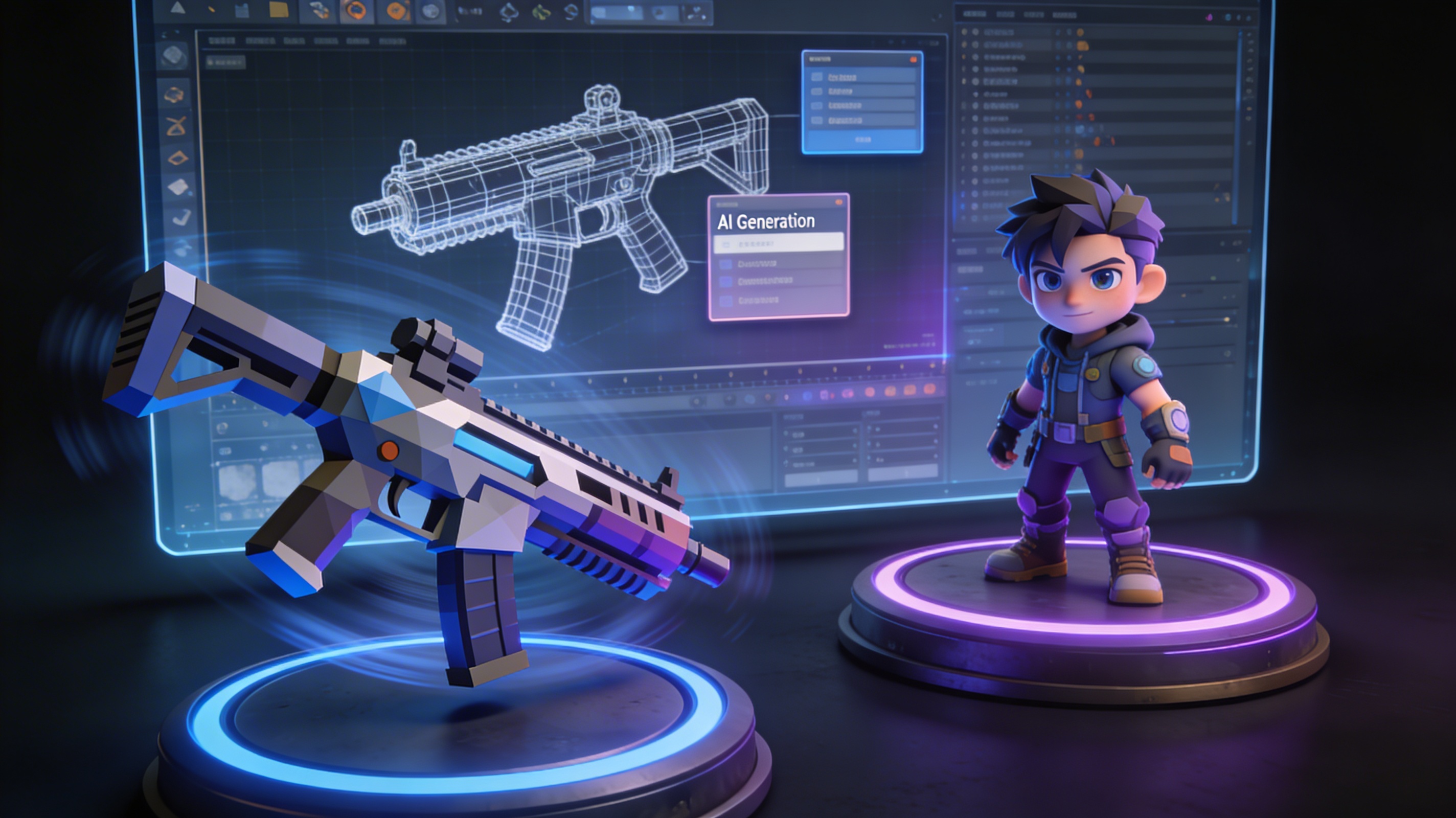
Hyper3D has emerged as a leading game 3D model generator, offering a comprehensive suite of tools for indie developers. With features like text-to-3D, image to 3D, and a dedicated AI character design tool, Hyper3D streamlines the entire asset creation pipeline. The platform offers various generation modes, including Gen-2, Default, Focal, Zero, and Speedy, allowing for a high degree of customization. Also, it supports a wide range of export formats such as STL, FBX, OBJ, GLB, and USDZ, ensuring smooth integration with popular game engines. Hyper3D's ecosystem also includes OmniCraft for editing and format conversion, and ChatAvatar for generating faces and avatars, making it a truly versatile solution for indie developers.
Scenario
Scenario is another powerful AI tool that specializes in creating unique in-game assets. It uses neural networks to analyze existing art styles and generate new characters, items, and backgrounds that are consistent with your game's aesthetic. This is particularly useful for maintaining a cohesive visual identity throughout your project. Scenario's ability to learn and adapt to a specific art style can save countless hours of manual work, ensuring that all generated assets feel like they belong in the same world.
Promethean AI
For world-building, Promethean AI is an excellent choice. This tool uses procedural algorithms to generate props, lighting, and terrain based on your defined parameters. It can save you countless hours of manual work, allowing you to focus on the creative aspects of level design. Promethean AI can be thought of as an assistant that helps you populate your game world with relevant assets, making it feel more alive and detailed.
Ludo.ai
Ludo.ai is a creative partner for game developers, offering a suite of tools to assist with everything from brainstorming to asset creation. It can generate game concepts, characters, and even entire game mechanics based on your input. Ludo.ai is a great tool for overcoming creative blocks and exploring new ideas for your game.
AI Tools for Animation
Bringing characters to life with fluid and realistic animations is crucial for creating an immersive player experience. AI animation tools can help you achieve this with greater ease and efficiency.
Cascadeur
Cascadeur is a physics-based animation tool that excels at creating realistic character movements. It analyzes your character's rigging and weight distribution to produce natural-looking animations, from simple gestures to complex acrobatic sequences. This can significantly reduce the time you spend on manual animation retakes. Cascadeur's deep learning tools can even predict and suggest the most physically accurate movements, making the animation process more intuitive.
Mixamo
Mixamo, by Adobe, offers a vast library of ready-to-use animations for humanoid characters. While not strictly an AI tool in the generative sense, it uses machine learning to automatically rig your characters and apply animations, saving you a significant amount of time and effort. Mixamo is an excellent resource for indie developers who need to quickly create high-quality animations without a dedicated animator.
AI Tools for Texturing, Coding and Sound
Beyond asset creation and animation, AI is also making its mark in other areas of game development, such as texturing, coding and even sound design.
Hyper3D's AI Texture Generator
In addition to its 3D modeling capabilities, Hyper3D also offers an AI texture generator. This tool can create smooth, high-quality textures from text prompts, helping you to quickly and easily texture your 3D models. The ability to generate textures on the fly allows for rapid iteration and experimentation, helping you to find the perfect look for your game.
Rosebud AI
Rosebud AI is a big deal for developers who are not expert coders. This tool can generate code from text prompts, allowing you to create functional prototypes and core gameplay mechanics without writing a single line of code. This can dramatically speed up your development process and enable you to validate your ideas more quickly.
FMOD
FMOD is a powerful audio middleware that is increasingly incorporating AI-powered features. It can be used to create dynamic and adaptive audio that responds to the player's actions and the game's state. While not a generative AI tool in the same vein as the others on this list, its use of AI for procedural and adaptive audio is a significant development for indie game sound design.
My First-Hand Experience with AI Tools for Indie Game Dev
As an indie developer myself, I've had the opportunity to use several of these AI tools in my own projects. I recently used Hyper3D's AI 3D model generator to create a main character for a new game concept. The process was incredibly fast and intuitive. I simply typed in a description of the character I wanted, and within minutes, I had a high-quality 3D model ready to be animated. I then used Cascadeur to create a walk cycle for the character. The physics-based approach of Cascadeur made the animation look incredibly realistic, and I was able to achieve a result that would have taken me days to create manually.
Of course, these tools are not without their limitations. While Hyper3D is excellent for generating initial concepts and base models, I still find it necessary to use a traditional 3D modeling tool like Blender for fine-tuning and adding intricate details. Similarly, while Rosebud AI is great for prototyping, it's not yet capable of writing complex, production-ready code. However, by using these ai tools for indie game dev in conjunction with traditional development methods, I've been able to significantly speed up my workflow and create higher-quality games.
Objective Comparison of AI Game Dev Tools
| Tool | Key Features | Pricing | Target Users |
|---|---|---|---|
| Hyper3D | Text-to-3D, Image-to-3D, AI Character Design, AI Texture Generator, OmniCraft, ChatAvatar | Freemium | Indie developers, solo developers, artists |
| Scenario | AI-powered asset generation, style consistency | Subscription-based | Game studios, artists |
| Promethean AI | Procedural world-building, prop and terrain generation | Enterprise | Mid-to-large game studios |
| Ludo.ai | Game concept generation, character creation, asset creation | Freemium | Indie developers, designers |
| Cascadeur | Physics-based animation, realistic character movement | Freemium | Animators, indie developers |
| Mixamo | Auto-rigging, large animation library | Free with Adobe ID | Indie developers, animators |
| Rosebud AI | Code generation from text prompts, rapid prototyping | Subscription-based | Developers, designers |
| FMOD | AI-powered adaptive audio | Per-project licensing | Sound designers, developers |
FAQ about AI in Indie Game Development
Will using AI in my indie game hurt sales?
Not necessarily. While there has been some debate in the gaming community about the use of AI-generated assets, most players are more concerned with the overall quality and fun factor of a game. If you use AI tools to create a better game, it's unlikely to have a negative impact on your sales. The key is to be transparent with your audience and to use AI as a tool to enhance your creativity, not as a crutch.
Can AI replace game developers?
It's highly unlikely that AI will replace game developers entirely. While AI can automate many tasks, it still lacks the creativity, critical thinking, and problem-solving skills of a human developer. AI should be seen as a tool to augment human creativity, not replace it. The role of the game developer will likely evolve to focus more on high-level creative direction and design, while AI handles the more tedious and repetitive tasks.
What are the best free AI tools for indie game developers?
Many of the tools mentioned in this article, such as Hyper3D, Cascadeur, and Mixamo, offer free tiers or versions that are perfect for indie developers on a budget. Ludo.ai also has a free plan that is great for brainstorming and generating initial ideas. It's always a good idea to start with the free versions of these tools to see if they fit your workflow before committing to a paid subscription.
How can I learn to use these AI tools effectively?
Most of these tools have extensive documentation, tutorials, and community forums to help you get started. The best way to learn is to simply dive in and start experimenting with them in your own projects. Don't be afraid to try different prompts and parameters to see what kind of results you can achieve. Joining online communities and forums dedicated to these tools can also be a great way to learn from other users and get help when you're stuck.
What is the future of AI in game development?
The future of AI in game development is incredibly exciting. We can expect to see even more powerful and intuitive AI solutions that will further democratize game development and enable developers to create even more immersive and innovative experiences. We may see AI tools that can generate entire game levels, write complex narrative structures, and even create unique gameplay mechanics on the fly. The possibilities are truly endless.
to wrap up, ai tools for indie game dev have become an essential part of the modern indie game developer's toolkit. By embracing these powerful new technologies, you can streamline your workflow, reduce costs, and create games that were once thought to be impossible for small teams to achieve. So why not give them a try? You might be surprised at what you can create.